


What home cook hasn’t dreamed of owning an extravagantly expensive copper cookware set and feeling like a romantic French chef in a Paris kitchen? Let’s admit it: even if you don’t cook at all, such a shiny and gorgeous set would make your kitchen look designer fabulous! In addition to adding a decorative flair, copper conducts heat better than any other material, propagating the heat quickly but evenly through the whole utensil, without any of those annoying burns you get with stainless steel. Copper also lasts practically forever, and like cast iron and clay it boosts the flavor of some particular foods.
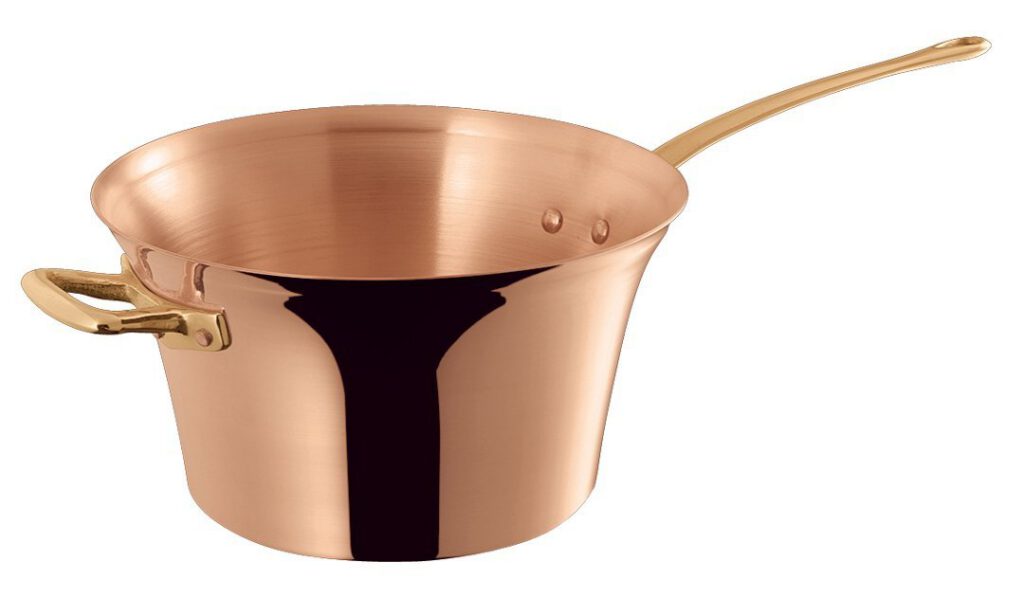
And how could I not mention polenta, the symbol of cucina povera (peasant cooking) in Northern Italy – which has recently made inroads in the trendiest New York City restaurants? A basic cornmeal and water mush served on a wooden cutting board, delicious with hearty stews or artisanal cheeses, the best polenta is always made in a heavy-gauge unlined copper pot with flared sides, a paiolo. It’s hard to explain, but the “flavor” of copper is part of “real” polenta, and lends it a depth that’s a
far cry from the blandness of any prepackaged and instant versions.
Get my recipe for authentic polenta here.
There is a misconception that copper utensils are not easy to take care of. Nowadays, there are many commercial products that make it a breeze to shine your set to perfection.
However, the most natural and effective system is what grandma taught me: washing with hot water and Marseille soap, and shining with a “scrub” made of equal parts of corn flour, white vinegar, and kosher salt.
When to avoid cooking with copper: Like the other “reactive” metals (aluminum, copper, iron, and steel when not ‘stainless’), copper also reacts with acidic and alkaline foods: preparations with tomatoes or lemon juice can take on a metallic flavor, and light-colored foods, like eggs, can develop gray streaks.Foods will also pick some copper from the cookware, especially if you cook preparations with acidic ingredients for a long time, and if they are left to cool down in the pot. While iron is processed easily by our bodies and has health benefits, copper or aluminum can build up in the body with harmful effects. This doesn’t happen with occasional use, but you should avoid copper for everyday usage and storage.
Temporary solution: To eliminate this problem altogether, manufactures have lined the inside of copper pots and pans with tin or stainless steel. Unfortunately, this type of cookware is outrageously expensive and the lining gets damaged over time. Damaged stainless lining cannot be fixed– which means you lose on the main advantage of copper, its durability! Tin can be redone, but it has a disadvantage: it cannot withstand the same high temperatures as copper. This makes tinned copper utensils less than ideal for some of copper’s otherwise most perfect matches: candy, chocolate, and jam-making. All of these need to cook evenly, quickly and at high heat, which only pure (unlined) copper can achieve, particularly when its thickness at the bottom is between 2 and 2.5 mm.
Scroll to continue
More Love
Use only UNSOLDERED copper pots, for the best flavor, I bought my Ruffoni on Amazon.
This article is part of a series on “pots & pans” published in Joy Of Kosher Magazine. Some other pots & pans included are crock pots & pressure cookers, for more information and recipes Subscribe Today








Leave a Reply