


Fresh or Frozen?
Fresh Turkeys
- Allow 1 pound of turkey per person.
- Buy your turkey only 1 to 2 days before you plan to cook it.
- Keep it stored in the refrigerator until you’re ready to cook it. Place it on a tray or in a pan to catch any juices that may leak.
- Do not buy fresh pre-stuffed turkeys. If not handled properly, any harmful bacteria that may be in the stuffing can multiply very quickly.
Frozen Turkeys
- Allow 1 pound of turkey per person.
- Keep frozen until you’re ready to thaw it.
- Turkeys can be kept frozen in the freezer indefinitely; however, cook within 1 year for best quality.
- See “Thawing Your Turkey” for thawing instructions.
Thawing Your Turkey
There are three ways to thaw your turkey safely — in the refrigerator, in cold water, or in the microwave oven.

Scroll to continue
More Love

Jamie’s Ultimate Kosher Thanksgiving Menu
Thanksgiving is more than just a meal—it’s a celebration of abundance, family, and …
Kosher Turkey Buying Guide
Super-nutritious, low in fat, inexpensive and extremely versatile, turkey is one amazing …
Keep the turkey in its original wrapper. Place it on a tray or in a pan to catch any juices that may leak. A thawed turkey can remain in the refrigerator for 1 to 2 days. If necessary, a turkey that has been properly thawed in the refrigerator may be refrozen.
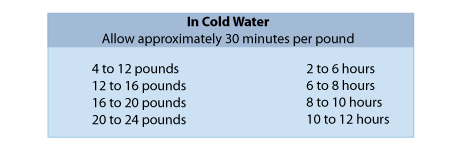
Wrap your turkey securely, making sure the water is not able to leak through the wrapping. Submerge your wrapped turkey in cold tap water. Change the water every 30 minutes. Cook the turkey immediately after it is thawed. Do not refreeze.
In the Microwave Oven
- Check your owner’s manual for the size turkey that will fit in your microwave oven, the minutes per pound, and power level to use for thawing.
- Remove all outside wrapping.
- Place on a microwave-safe dish to catch any juices that may leak.
- Cook your turkey immediately. Do not refreeze or refrigerate your turkey after thawing in the microwave oven.
REMINDER: Remove the giblets from the turkey cavities after thawing. Cook separately.
Roasting Your Turkey
- Set your oven temperature no lower than 325 °F.
- Place your turkey or turkey breast on a rack in a shallow roasting pan.
- For optimum safety, stuffing a turkey is not recommended. For more even cooking, it is recommended you cook your stuffing outside the bird in a casserole. Use a food thermometer to check the internal temperature of the stuffing. The stuffing must reach a safe minimum internal temperature of 165 °F.
- If you choose to stuff your turkey, the ingredients can be prepared ahead of time; however, keep wet and dry ingredients separate. Chill all of the wet ingredients (margarine, cooked celery and onions, broth, etc.). Mix wet and dry ingredients just before filling the turkey cavities. Fill the cavities loosely. Cook the turkey immediately. Use a food thermometer to make sure the center of the stuffing reaches a safe minimum internal temperature of 165 °F.
- A whole turkey is safe when cooked to a minimum internal temperature of 165 °F as measured with a food thermometer. Check the internal temperature in the innermost part of the thigh and wing and the thickest part of the breast. For reasons of personal preference, consumers may choose to cook turkey to higher temperatures.
- If your turkey has a “pop-up” temperature indicator, it is recommended that you also check the internal temperature of the turkey in the innermost part of the thigh and wing and the thickest part of the breast with a food thermometer. The minimum internal temperature should reach 165 °F for safety.
- For quality, let the turkey stand for 20 minutes before carving to allow juices to set. The turkey will carve more easily.
- Remove all stuffing from the turkey cavities.
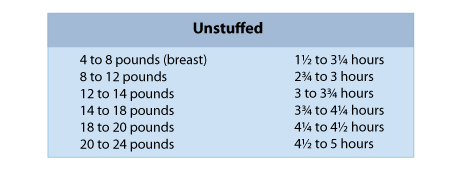
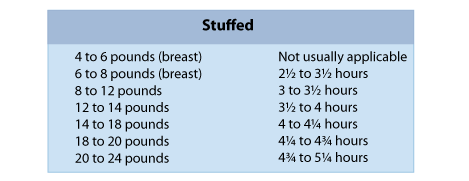
Timetables for Turkey Roasting
(325 °F oven temperature)
Use the timetables below to determine how long to cook your turkey. These times are approximate. Always use a food thermometer to check the internal temperature of your turkey and stuffing.
Optional Cooking Hints
It is safe to cook a turkey from the frozen state. The cooking time will take at least 50 percent longer than recommended for a fully thawed turkey. Remember to remove the giblet packages during the cooking time. Remove carefully with tongs or a fork.
- Tuck wing tips under the shoulders of the bird for more even cooking. This is referred to as “akimbo.”
- Add ½ cup of water to the bottom of the pan.
- If your roasting pan does not have a lid, you may place a tent of heavy-duty aluminum foil over the turkey for the first 1 to 1 ½ hours. This allows for maximum heat circulation, keeps the turkey moist, and reduces oven splatter. To prevent overbrowning, foil may also be placed over the turkey after it reaches the desired color.
- If using an oven-proof food thermometer, place it in the turkey at the start of the cooking cycle. It will allow you to check the internal temperature of the turkey while it is cooking. For turkey breasts, place thermometer in the thickest part. For whole turkeys, place in the thickest part of the inner thigh. Once the thigh has reached 165 °F, check the wing and the thickest part of the breast to ensure the turkey has reached a safe minimum internal temperature of 165 °F throughout the product.
- If using an oven cooking bag, follow the manufacturer’s guidelines on the package.
REMEMBER! Always wash hands, utensils, the sink, and anything else that comes in contact with raw turkey and its juices with soap and water.
Storing Your Leftovers
- Discard any turkey, stuffing, and gravy left out at room temperature longer than 2 hours; 1 hour in temperatures above 90 °F.
- Divide leftovers into smaller portions. Refrigerate or freeze in covered shallow containers for quicker cooling.
- Use refrigerated turkey and stuffing within 3 to 4 days. Use gravy within 1 to 2 days.
- If freezing leftovers, use within 2 to 6 months for best quality.
Reheating Your Turkey
Cooked turkey may be eaten cold or reheated.
In the Oven
- Set the oven temperature no lower than 325 °F.
- Reheat turkey to an internal temperature of 165 °F. Use a food thermometer to check the internal temperature.
- To keep the turkey moist, add a little broth or water and cover.
In the Microwave Oven
- Cover your food and rotate it for even heating. Allow standing time.
- Check the internal temperature of your food with a food thermometer to make sure it reaches 165 °F.
- Consult your microwave oven owner’s manual for recommended times and power levels.




There are lots of different opinions on how to make the best turkey, hope yours came out great.
when do you baste the turkey and when do you tent it with foil? I have a 14lb. defrosted turkey that I prepared tonight and ready to go in oven first thing tomorrow am?
By far the simplest & clearest approach for roasting a turkey. Hope it goes well for our Rosh celebration.
this is a great thorough guide for roasting turkey, thank you!