


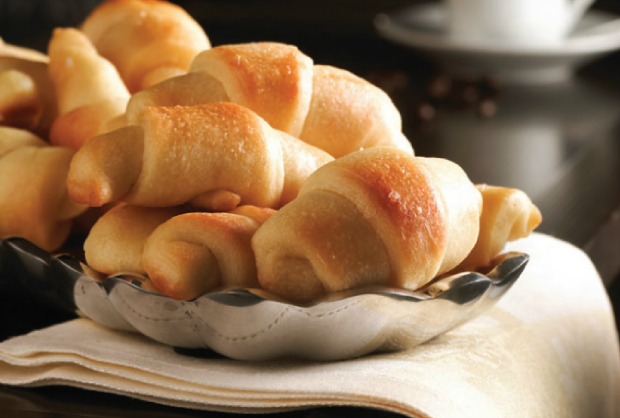
Rugelach, meaning “little twists” in Yiddish, originated in Eastern European Jewish communities. The rugelach is something of a hybrid pastry, resembling a small croissant at first glance but boasting the consistency of a danish. To further confuse matters, rugelach are also sometimes mistaken for schnecken pastry which are rolled and sliced like the American sticky bun. Either way, rugelach are in good company in their large extended family collectively known as viennoiseries. Whatever you decide to call them, we highly recommend baking up a batch today!
Simply Irresistible Rugelach
Servings
96 Servings
Ingredients
- 12 cups flour
- 1 tablespoon salt
- 2 cups sugar
- 4 ounces instant dry yeast 4 envelopes
- 3 whole eggs plus 4 yolks reserve egg whites for assembly
- 2 cups oil
- 3½ cups water
- 2 teaspoons pure vanilla extract
- ½ cup vanilla sugar
- 1 cup confectioner’s sugar
- 1 cup confectioners’ sugar
- 2 tablespoons cocoa powder
- ½ cup brown sugar
- 1 tablespoon cinnamon
- ½ cup oil
- 4 egg whites slightly beaten
Instructions
- Rugelach dough
- Place the flour, salt and sugar in the bowl of an electric mixer fitted with the dough hook. Add yeast, followed by the eggs, egg yolks, oil, water and vanilla extract. Mix at low speed until dough forms. The dough will be wet. Transfer dough to a large oiled bowl, cover with plastic wrap or a towel and allow to rise for 1 hour 15 minutes.
- Filling
- Mix the ingredients for filling of choice in a small bowl and set aside.
- Assembly
- Preheat oven to 350°F and line baking sheets with parchment paper.
- Once the dough has risen, punch it down and separate into 6 pieces. Roll out each piece of dough into a thin circle, using a rolling pin, and brush with a thin layer of oil. Cut into 16 equal pieces as though slicing a pizza, forming triangles. Place a spoonful of filling at the wider end of each triangle, rolling from that end toward the pointy tip. Transfer to prepared baking sheets and brush the rugelach with the beaten egg whites.
- Bake for approximately 15 to 20 minutes until golden. Remove from oven and allow to cool on baking sheets for 5 minutes then transfer to wire racks to cool completely. Store in an airtight container for up to one week at room temperature or freeze for up to two months.
- Source: And Then There Was Cake from the Hebrew Academy of Montreal. Copies can be ordered at HA-Cookbook.com or by calling 514-489-5321.





I’d like to try this, but measurements make no sense to me. If my basic challah dough uses 6 cups of flour with 1-1/2 cups of water, 1/2 cup of oil and a scant tablespoon of active dry yeast, how can the 12 cups of flour in that recipe take so much oil and yeast?
Thanks you so much for sharing this – glad it turned out in the end and is good to have the full recipe in case you are hosting a party 🙂
So sorry about that. We have a few other rugelach recipes. It is strange that some people have loved it and some have so much trouble. Maybe it is the kind of flour.
So, here’s the funny thing, I was tempted to chuck the whole thing, but was hesitant to throw out so much, so I just kept adding flour until I had something I could work with. ( even after the rise I still had to add another cup at least) in my head I said I would never use this recipe again…AND THEN it produced the most beautiful delicious rugelach…granted it was after Tish B’Av, but the family could not stop complimenting, and even packed some to take home. LOL. I will cut the recipe in half next time, as it is it is too big to properly mix in a standard mixer, even an original Kitchenaid which is what I use, and the orig recipe makes 96 pieces…who needs that many normally?!
There is something seriously wrong with the flour to liquid ratio! I am an experienced baker and renowned for my challah but following these directions I end up with a large sticky wet mess. Can barely call it a dough! Also the recipe is too large for a standard mixer!
I just made this recipe and I too am regretting it already. Not sure what it means by dough will be wet, and I am an avid baker and it barely qualifies as dough. Wasn’t sure if I should add more flour, but now I am sorry cuz 12 cups, plus all the other ingredients is too much for a standard mixer (and I have the original Kitchenaid! I followed the recipe exactly and it is a lot of liquid!
Hmm, I would go with 4 envelopes of dry yeast. Perhaps it meant to say 4 ounces fresh yeast or 4 packets? The dry to liquid ratio looks ok, it could be that you were baking on a really humid day and needed even more flour. I know you swore off this recipe, but others had great results! Next time try adding more flour if it looks super sticky. Yeast doughs aren’t as easy as cakes and cookies, they react differently in different weather and altitudes and need to be adjusted each time they are made.
To make a smaller batch, just half the recipe! For the eggs I would do one whole egg and 3 yolks.
Also, four ounces of yeast is NOT the same as four envelopes! as one envelope is only 1/4 ounce. Can someone give me the correct measurement of yeast? If that’s a mistake, maybe there’s an error with the liquid amount as well?
I made these rugelach for the first time, and had an awful time with itl. The recipe warned that the dough should be wet, but mine was more like cake batter! I had to add another full cup of flour, at least, and even that didn’t do it. The dough was incredibly sticky and impossible to work with. I managed to bake off the whole batch of rugelach, and my friends liked the taste, but I swore it off. I really want a great yeast rugelach to make, but can’t figure out what I did wrong here! Help!
Made these yesterday and they are auper and amazing. Easy to work with dough and beyond delicious. And no margarine… What can get better! But yes it makes allot of rugelach
this makes to many pieces how do you make a smaller batch?
Just finished making rugelach! So good. Nice to have a good yeast version, though mine are not. Thanks.