


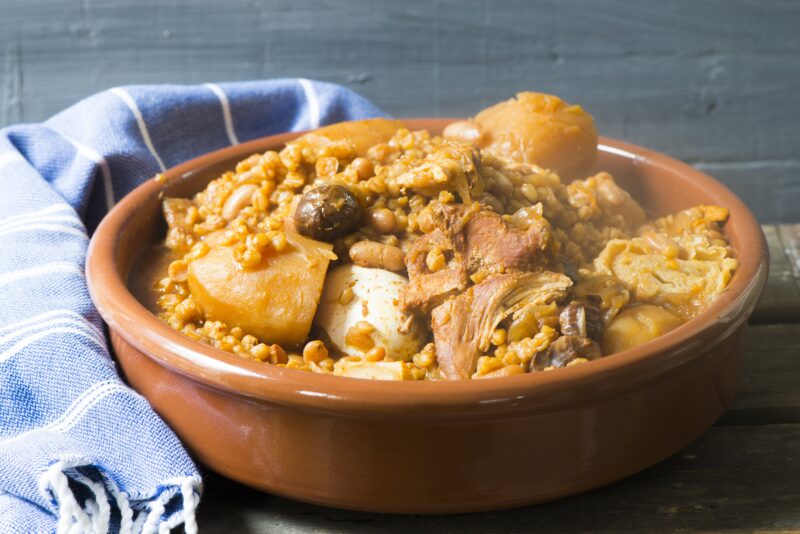
Cholent – no two are alike, not even two in the same house, made week after week in the same pot. There’s always a little something different or special about the cholent in my house.
Maybe that’s because we don’t measure. Okay, I’ll fess up. I’m using “we” very liberally, as in “we need to take out the trash.” Translation: “Hubby, the trash is overflowing and I can’t take it anymore!”
So “we don’t measure” means Hubby doesn’t measure. The famous family heirloom cholent recipe is his, or more precisely, his father’s. In the Geller house, cholent is a MAN thing, to the point that even after we were married and agreed to share everything — from our bank account to our bathroom — he wouldn’t reveal the secrets of his divine, hot, gem of a cholent.
Then one Friday afternoon, he wasn’t feeling 100%. His choice was to entrust the recipe to me, or live without cholent for an entire Shabbos. A no-brainer. I was pressed into service and Hubby directed me like an army general. “Potatoes and onions first on the bottom!” he thundered. “Beans and barley, now shake ‘em so they fall into the crevices!” I shook. “Meat around the sides – no, no, bones out — bones facing out!” The pressure was so intense, I almost didn’t want to know the recipe anymore. I didn’t want to make cholent ever.
But I did. And eventually Hubby came through for me too. He gallantly measured his cholent ingredients for the sake of my cookbook. Now it’s a famous recipe and was even featured in the NY Times. (How crazy is that? They did make one change though, and Hubby will never forgive them.)
See us in action making the cholent here:
Yet no matter what I do, mine never comes out just like his. I guess it remains his job forever, well that was until we decided or our Doctor decided for us that we couldn’t sustain a diet of weekly cholent that looked like this one and so I developed a healthier cholent for us to eat regularly and we save this one as a special treat.
Scroll to continue
More Love
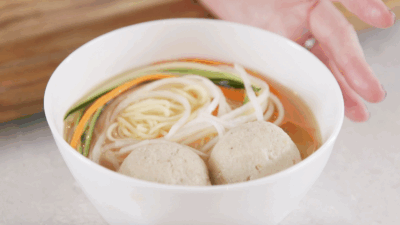
The Ultimate Shabbat Menu Guide
What you have here is a very classic Ashkenazi Shabbat menu. These are …
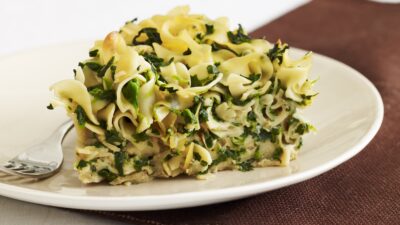
The History of Kugel
What Is Kugel? When the word kugel first appeared in Webster’s Dictionary in the early …
Now for the cleaning, get my tips on how to clean a crusty slow cooker, some people use a cooking bag to avoid the hassle.
Some cholent facts:
Cholent was invented to prove that Jews could and should eat hot food on Shabbos, even though cooking on Shabbos isn’t allowed. (Really. The challenge came from a sect called Karaites who insisted that the Shabbos laws meant that we must literally eat cold food.) Some brilliant person (probably a Geller ancestor) came up with the idea of pre-cooking a magnificent stew on Friday and keeping it hot all Shabbos.
Cholent is also known as – dafina or hamin (meaning “hot stuff”), depending on where your ancestors are from.
Cholent staples – beans, barley, meat, and potatoes.
Cholent seasoning – anything your tummy can handle. We use paprika, pepper, honey and consommé mix, and I’ve heard that people use everything from beer to peanut butter to cinnamon to eggs, to hot dogs, to pastrami, to squash to bbq sauce. Some folks even use all of those together. Anything goes!
The Great Bean Debate: There are those that soak the cholent beans overnight before they cook them, and those that say that it makes no difference. If you soak the beans overnight it reduces the cooking time – but when you are slow-cooking for almost 24 hours it doesn’t really make that much difference. However, soaking them may reduce the gaseous effect of them. It also cleans a lot of the dirt off of them that mere washing might not.
A way to get around the Great Bean Debate: use canned baked beans!
And why shouldn’t your crockpot get a weekday workout too? Now is the time — while it’s freezing outside (at least in some places) – to enjoy slow-cooker recipes. Take a look at the hearty stews, slow cooker vegetarian dishes, and even some crockpot desserts — that will make your house smell amazing!
Learn more about the history of cholent and get 25 cholent recipes here.





Hi Jamie, Nice article. I have news about soaking beans that might be helpful. Dry beans contain an inhibitor that stops the enzyme action of the beans. This same inhibitor is what causes gas. So, you should only soak them and they’ll be, bottom line, less greps and futz.
Which nobody really needs….
My favorite slow cooker, Sabbath recipe is a dish I call Israeli Chicken. I adapted it from 3 different recipes, neither of which utilized a crock pot. The original recipes I adapted from are from Faye Levy’s 1,000 Jewish Recipes cookbook. This is my recipe adapted from those:
I use just chicken thighs because I love them but you can use any chicken pieces. I wouldn’t use just breasts though because there is no flavor and little fat. Mix equal parts (1 to 2 tsp) garlic powder, black pepper, cumin, coriander, turmeric and paprica. Salt can be added also. Rub chicken pieces liberally and set aside.
Saute chicken thighs (bone in or boneless) in olive oil until browned. Remove to a large bowl in batches. When all have been browned, add 2 large spanish onions (large dice) and saute until they begin to soften and become fragrant. Add about 1 cup white wine to deglaze the pan. Add chicken pieces to crockpot and layer with onions. Make sure to dump in all those wonderful juices.
Allow to cook until tender which will vary between cookers. If you use just thighs you can’t really overcook this. Another reason I love the thigh portions.
I serve with either couscous, Israeli salad, pita and hummus. The next day after Sabbath I shred the chicken and mix with the leftover couscous for a Saturday evening meal.
This is also good served with a rice pilaf.
My favorite slow cooker recipe is my version of coq au vin. It’s four to six boneless, skinless chicken breasts, 1-2 small onions sliced into rings (you could saute the onion before for a richer flavor), 1-2 cans of onion soup (I use Rokeach’s brand), 2- 3 tablespoons of olive oil or melted pareve margarine, 1 – 2 cans of of petite diced tomatoes, salt, pepper, onion powder, garlic powder, rosemary, thyme and margoram. Put all in crock pot and cook on high 4-6 hours or low 8-10 hours. You would have to adjust for your crock pot, of course. I tend to cook mine longer because I like the au jous to cook down alot and it make for a wonderful sauce to spoon over the chicken when serving. It tastes good on rice and mashed potatoes. I like this recipe because my family loves coq au vin and when I make a brisket I tend to use this same recipe. It translates very well to beef.