


When one examines the history of Jewish Food, one of the most striking aspects is how unified we are within our diversity. As the most globalized nation on Earth, we have spread literally everywhere, and our cuisine clearly reflects that. But when you see the common elements that pop up in Jewish dishes around the world, you can’t help but realize that throughout the millennia of our wanderings through the diaspora, we have remained one unified people.
A perfect example of this is the Shabbat stew, a term I use to collectively refer to the numerous dishes that Jews worldwide have prepared on Friday and left slow-cooking through the night in order to have a hot lunch on Saturday. Of course, we have cholent in Ashkenaz, and hamin among Sephardim, but other examples include Bukharian osavo, Moroccan dafina or skhena, or Alsatian choucroute garnie.
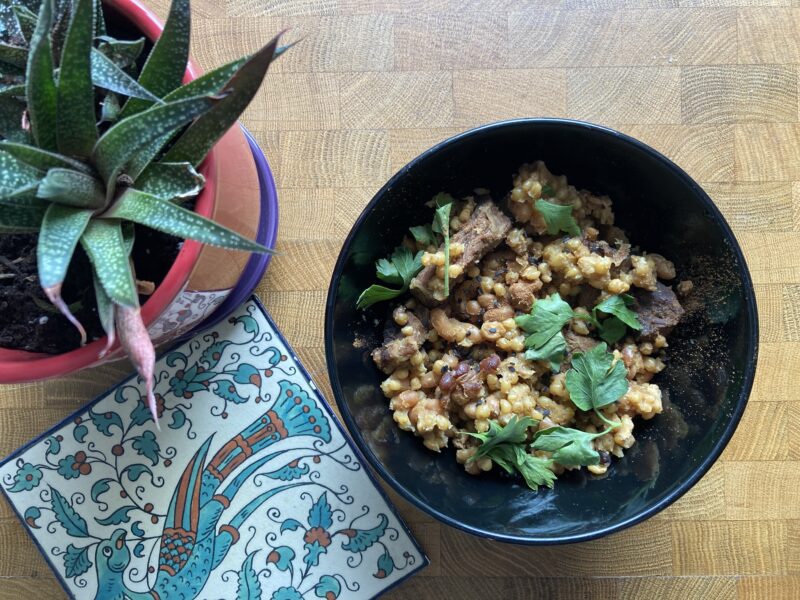
As I’ve researched these for a book I am writing on the history of Shabbat stews, I have found that we can trace them all back to an ancient dish of the Middle East, known as harisa (not to be confused with the spicy North African paste of the same name). It combines wheat and meat into a stodgy porridge, of sorts. In my recently released free e-cookbook of 12 international Shabbat stew recipes, I specifically chose one example because of its historical connection to harisa.
Today, Jews from Egypt to Yemen and Kurdistan all make Shabbat stews that resemble harisa. But its closest descendant today is haleem, popular among the Persian community from Esfahan, Iran. While it maintains the core of the original dish, a few changes have been introduced in more modern times.
Some prefer their haleem with turkey meat instead of beef or lamb, and most add white beans into their pot. Both of these are “New World foods,” meaning that they were unknown in Europe until after Columbus’ arrival in the Western Hemisphere, and took even longer to arrive in Iran. These changes slightly lighten what otherwise would be a particularly heavy dish.
Most notable, however, is what did not change from the past to the present. Anyone who has ever eaten in a Persian restaurant or home knows of that community’s passion for rice. But haleem is still made with wheat, as was harisa in the past. Finding a Persian dish that prominently and universally uses a grain other than rice underscores its antiquity.
This one Shabbat stew, with its ties to the past and its modern alterations, testifies to the long history of Jews in Iran and in the wider region around it. And by tracing its connections to dishes such as cholent and hamin, we can celebrate the unity of the Jewish people while also embracing our individual communities.
Notes: The wheat may be soaked overnight, or should be rinsed thoroughly in cold water.
Scroll to continue
More Love

Classic Cholent
The Best Classic Cholent Recipe: Shabbat Morning Comfort, Just Like Bubby Made Growing up, …
Soft and Chewy Nougat
Are you searching for a truly soft and chewy Italian nougat recipe? I can tell you …
If using beef, boil it briefly in water and skim off the foam before adding the rest of the ingredients.
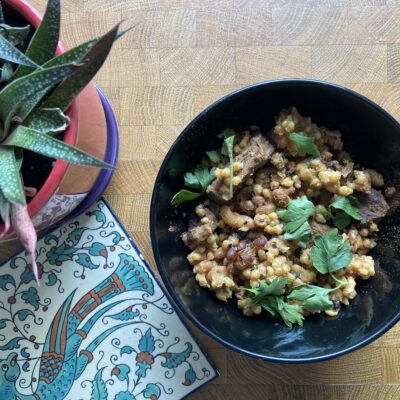
Esfahani Haleem – An Old-New Shabbat Stew
Servings
Ingredients
- 2 pounds 900 g beef or 2 turkey legs and 2 turkey necks
- 1 pound 450 g split (shelled) wheat or wheat berries
- 1 pound 450 g white beans
- 1 large onion chopped
- 1 tablespoon turmeric
- 1 teaspoon salt
- 1 teaspoon black pepper
Instructions
- In a large heavy pot such as a Dutch oven over low heat, add beef or turkey, wheat berries, white beans, onion, turmeric, salt and pepper. Cover with water, stir, and bring to a boil. Reduce heat and simmer for 1 hour. Stir periodically to make sure the bottom doesn’t burn. If you see the stew is getting too thick, pour in some boiling water to loosen it up.
- If you are using turkey rather than beef, remove the meat from the bones and return it to the pot with the skin. Discard the bones.
- Place pot on a hot plate or in the oven at 230° F / 110° C and let it cook low and slow overnight. (Alternatively, you can move everything to a slow cooker)Place aluminum foil between the lid and the pot to keep the moisture in. Fold the edges of the foil up over the lid, so the steam doesn’t drip down the outside of the pot, making a mess.
- Option for serving: sprinkle cinnamon and/or sugar on top.
- Note: If the haleem is too thick at serving time, you may stir through some water, or even better, olive oil.






Leave a Reply