


Tradition means a lot to my family. Because of this, I could never suggest, on Thanksgiving of all days, that they try to evolve. But unlike my family, I think tradition is a give and take — a little questioning and a little embracing. That’s why I want to share my family’s recipe for gondi with you, and politely … hopefully … cautiously suggest that you consider bringing a new tradition to this year’s Thanksgiving table.
Gondi, pronounced go-n-dee, is a uniquely Persian Jewish dish usually served on Shabbat. Traditionally, the gondi are made from chickpea flour, ground meat, and served in a clear broth. But in my family, we do it better. The ground turkey is loaded with cups and cups of all the best herbs, spiced up, and cooked in a dried lemon and tomato sauce. This dish is intensely comforting, and I hope that you will welcome it to your Shabbat, every day life, and maybe even to your Thanksgiving table.
Recipe slightly adapted from a family recipe I received from my grandfather’s niece, Linda.
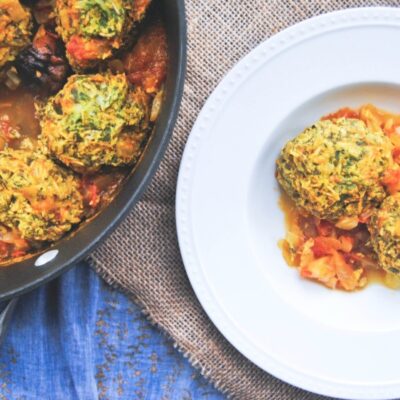
Gondi (Persian Turkey Rice Dumplings)
Servings
Ingredients
- 1 medium onion; diced about 2 cups
- 1/2 teaspoon olive oil
- 1 teaspoon salt
- 1 teaspoon ground turmeric
- 1/4 teaspoon ground pepper
- 3 tablespoon tomato sauce OR — I blended a can of diced tomatoes because I didn’t have tomato sauce and it was great
- 2 fresh tomatoes; diced about 1 cup
- 2 dried lemons; cracked or punctured – or 1 tsp dried lemon powder *you can find these at any Middle Eastern grocery store and sometimes at Asian markets.
- 6 cups of water or vegetable/chicken stock + approx 3.5 cups of water if you use brown rice (see below)
- 1 onion; ground about 1 cup
- 1 lb of ground turkey
- 1 cup raw white basmati rice*
- 2 bunches of parsley; finely chopped about 2 cups
- 1 bunch of cilantro; finely chopped about 1/2 cup
- 1 little bunch of mint; finely chopped about 1/4 cup
- 1 bunch of dill; finely chopped about 2 cups
- 1 bunch of tarragon; finely chopped about 1/4 cup
- 1 teaspoon turmeric
- 1 teaspoon salt
- 1/4 teaspoon pepper
- 1 teaspoon cumin
Instructions
- This dish can be made in advance, frozen and thawed when you’re ready to eat it. It also holds up well in the fridge for several days and, in my opinion, tastes better the longer it sits.
- Start with the sauce:
- In a large sauce pan, heat the oil over medium heat. Add the onions when the oil is hot enough that the onions would immediately sizzle. When the onions are translucent, add all the ingredients (tomato sauce, chopped tomatoes, salt, pepper, turmeric and dried lemons**) for the sauce except for the water. Saute for about ten minutes. Add the water and bring the sauce to a boil. Allow sauce to boil for about five minutes and then turn off the heat.
- **Note: to cook with dried lemon, use your hand or the bottom of a glass and apply pressure to the lemon. You want to crack it open so its unique aroma can pervade the stew. You can also use a knife and very carefully pierce part of the dried lemon in a couple of places. Same idea.
- For the gondi: Combine all the ingredients (ground onion, rice, cumin, turmeric, salt & pepper, herbs) and mix well with your hands. Bring the sauce back to a boil. Shape the gondi to the size of a tennis ball or slightly smaller and add them to the boiling sauce. Add just enough water to cover the gondi (this is so the rice fully cooks). You may need to push the gondi around in the pot to make enough room. Cook over a simmer for about 40 minutes.* You’ll know it’s ready when you taste part of the gondi and the rice is thoroughly cooked. Walk out of your home and then come back inside. OMG that smell! Welcome to my childhood.
- *Note: If you use brown rice, cook the gondi over a simmer for 1-1.5 hours, continuing to add water so that the gondi are always slightly covered. If you find your dish is more liquidy than you would like, cook it uncovered until the sauce reaches your desired thickness.
- *you can use brown rice if you prefer, but you will need to cook the gondi for 1 – 1.5 hours; also, continue adding water, approximately 3 cups, throughout the cooking process so the gondi remain submerged.
- For more pictures and information about Gondi, visit MyJerusalemKitchen.com.



Turkey meat is fairly new to Iran & Israel around the year 2000, major production started in both countries .
This reminds me of koofteh. It’s a meatball made with rice. Gondi is made with chickpea flour.
Authentic GONDI are not made with turkey or poultry but with beef. There is NO RICE in Authentic Persian GONDI just parsley,coriander, dill and other spices. There also NO SAUCE as the GONDI is cooked in chicken broth or soup and is not served with a sauce. It is served with fluffy basmati rice and Tadik. In Iran, saffron is also expensive, it would in place of the turmeric with a slight different taste. The author I don’t believe is a Parsi as this recipe I strongly believe is an Israeli version of Gondi. Just got off the phone with my friends nephew who was born in Shiraz, Iran. He told me this is a variation to the authentic Ghondi not authentic. If you will check other recipes, and if they too have utilized rice in their ingredients, it is not the original recipe. If anyone knows who MY JERUSALEM KITCHEN is, I would like to have them contact this nephew as he cooks a lot and lives in the Persian community in Los Angeles. If your into Persian cooking as I am, you have to try making Shami.
good to know regarding the rice inside the Gondi, I would cook the rice separately and serve with the sauce.
I made this for Shabbos. Whilst it was easy to make, in no time at all the turkey dumplings (probably because of the rice in them) soaked up all the sauce, so do not understand why it is stated the longer left in the fridge the better. I felt that the rice took over the dish and so one could not appreciate the other flavours and it was hard to get the taste of the turkey. The turmeric stained everything.