


Right now, in vineyards everywhere, grapes are being harvested for the wine that will land on your table next year—and beyond.
The Color Comes from the Skins
While the wine ferments in these stainless steel tanks, the skins and seeds rise to the top and form a cap. Winemakers “pump over” the liquid from the bottom of the tank over the solid cap to push the solids back down into the mix so those skins can continue coloring the wine. Later, the wine is most often filtered to remove any solids—then to the barrels it goes.
Do All Grapes Look the Same?
While some grow in looser bunches, and some tighter, and some have thicker skins, and others thinner, it’s almost impossible to tell a grape by looking at it—or even tasting it. So, marking the rows when planting grapes is essential. Cabernet Sauvignon may be the exception—it is the most distinguishable because its leaves form little “eyes.” The vines to the far left are growing at the Carmel Winery in the Dan region in Israel. The marked rows (to the far left) are in Sonoma County, California
Scroll to continue
More Love

The Promised Land of Single Malts: How Tel Aviv’s M&H is Redefining the Spirit of Israel
Sponsored content — all opinions and reviews remain entirely my own There is an old joke …

Add A Little Wine To Your Shabbat Menu
In Parshat Shoftim, we read of a remarkable exemption from military service for anyone who …
Training the Vines
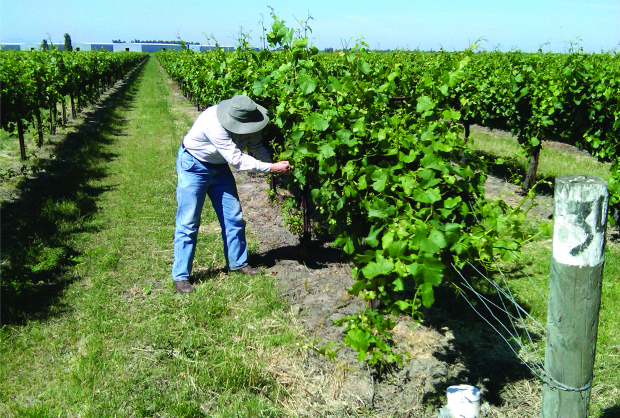
Vines like to grow wild. Here, Joe Hurliman, Chief Winemaker at Herzog Wine Cellars in Oxnard, California, is lifting the wires of a trellis system to encourage the vines to grow upwards, bringing the leaves to catch the sun, and making sure there is not too much shade around the grapes by pulling off some leaves. Shade prevents grapes from all ripening at the same time.
Limestone, Clay, or Terra Rossa
Different grapes thrive in different soils. The left bank of the Bordeaux region in France, which is planted primarily with Cabernet Sauvignon, has limestone soil, while the right bank’s clay soil is prime for Merlot. Israel—though a tiny country—has incredible soil diversity, allowing for various grapes to thrive. Up in the Golan Heights, volcanic eruptions have resulted in volcanic soil—just like in California’s Napa Valley. As you head west to the Upper Galilee, there will be more terra rossa, a dry red soil from red rock. Limestone is common in the Judean Hills. In California’s Alexander Valley, the soil is alluvial, or “chalk,” which is similar to limestone—and the spot where Herzog harvests the grapes for its Chalk Hill Cabernet. Chardonnay does well in different soils—but the regional conditions affect the flavor of the grape. Grown in France, the flavor is more reserved. In hot regions, tropical flavors emerge through the grape
Peel and Crush a Grape
The liquid inside most grapes is clear—the wine wouldn’t get its red color if it didn’t ferment together with its skin. The Petit Sirah grape is unique—it’s the only one with red juice.
Tiny Drips
Israel is a pioneer in “drip irrigation” technology. Today, this technology is used in countries where water is scarce. Drip irrigation technology works by placing hoses with tiny holes that “drip” just the right amount of water at the base of the vine. Vineyards in places such as California sometimes have huge overhead sprinklers to arbitrarily water crops, but there’s no reason to waste water and irrigate the dirt.
An Old Vine
The trunks on this Merlot vine have been trained to grow horizontally, around 18 inches off the ground, so they can thrive without climbing impossibly high. The thickness of this trunk means it’s an older vine, over 10, maybe even 20 or 30-years-old. As vines grow older, they produce less fruit—but with more concentrated flavor. The roots dig deeper searching for water and nutrients, imparting more complexity to the grape. That’s why wine from “old vine” vineyards are often more expensive. Eventually, when there is too little fruit, vines need to be uprooted and planted anew—though there are some vineyards, in Australia and even California, where 100 plus year-old vineyards still thrive. Interestingly, France does not have vines that old. In the late 19th century, the Phylloxera epidemic destroyed most of the vineyards in Europe, and particularly France. The pests were brought over from the United States by English botanists who collected specimens of American vines. The U.S. vines had already built up resistance to the pests.
Originally published in the Rosh Hashanah 2011 issue of Joy of Kosher with Jamie Geller.
Don’t miss our recommendations for New Wines for the New Year 2012.








Leave a Reply