


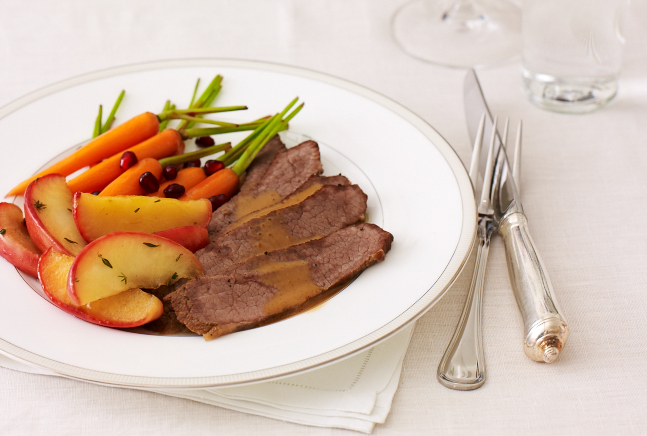
Apples and Honey are perhaps the most symbolic foods of Rosh Hashanah – the Jewish New Year.
And you all know the prayer that follows the apple dipped in honey. “May it be Your will, Hashem, our G-d and G-d of our fathers, that You renew for us a good and sweet year.” We all get that sweet year honey connection — but why do we eat apples on Rosh Hashanah?
When Yaakov masqueraded as Eisav to obtain his rightful “firstborn” blessing from his father, Yitzchak, he donned Eisav’s cloak. Yitzchak exclaimed, “the fragrance of my son is like the fragrance of a field that G-d had blessed” and blessed Yaakov. The Talmud identifies the fragrance as an apple orchard, and the Vilna Gaon says this happened on Rosh Hashanah. We eat apples (tons of them) because we too want those holy blessings given to Yaakov.
Since the custom of eating apples revives our memory of Biblical blessings, let’s combine it with a more recent, beloved tradition. Nu, what’s a Yuntif without brisket?
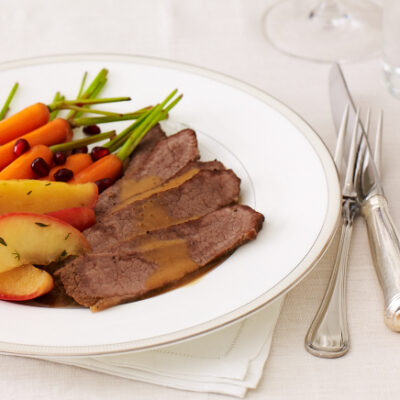
Roasted Apple Brisket
Servings
Ingredients
- 1 2 ½-pound beef brisket
- 3 tablespoons brown sugar
- 1 teaspoon kosher salt
- Freshly ground black pepper
- 2 tablespoons extra virgin olive oil
- 3 medium gala apples cored and cut into wedges
- 1 small bunch fresh thyme or 2 teaspoons dried thyme
- 2 cups apple juice
Instructions
- Preheat oven to 375° F.
- Season both sides of brisket with sugar, salt, and pepper. Heat evoo in a large Dutch oven over medium-high heat. Add brisket and brown 5 minutes on each side. Remove from the pan and set aside.
- Add apples to the pan, and cook 5 minutes or until nicely browned. Stir in thyme, and return brisket to the pan.
- Add apple juice, cover, and bake at 375° F for 1 ½ to 2 hours, or until tender.
- Remove brisket and apples from the Dutch oven and let rest.
- Transfer the pan to the stove and bring liquid to a boil over medium. Simmer for 15 minutes or until reduced by half. Pour into a gravy boat or serving bowl.
- Slice brisket into ¼-inch thick slices and place on a serving platter. Place cooked apples around brisket and serve with sauce on the side.


Yes you can do that.
I’m making a much larger brisket do i just double or triple the ingredient measurements?
I’m cooking a lot more brisket, do I triple the recipe?
This looks so awesome!!! I have to try this
Hi
I always make brisket with chilly sauce and coke but this year I’m looking for something new. Does this come out sweet or soury? Doesn’t it need more spices? This is going to be my main dish for chag and I need it to be perfect so that’s why all the questions:)
hey Jessica – in theory I guess you can but it’s a little easier to control the temp in the oven — yielding a softer brisket (which is what we all want, right ? 🙂
YAY so happy it’s exciting you 🙂 cider would be divine. I haven’t tried it in a slow cooker… but should be fine – just make sure there is enough liquid so it doesn’t dry out — depending on size of your slow cooker you may have to add more/double the liquid/juice/cider.
no Dutch oven NO worries – just cover tightly with foil. enJOY!
Hi Jamie ! I was wondering if it’s possible to cook this kind of dish in a pot also 🙂
What a great recipe for Rosh Hashanah! Have you ever made this in a slow cooker? Also, what do you think of using hard cider instead of the apple juice?
If I want to make this in a baking dish in advance (I don’t have a dutch oven) to reheat and serve on RH how would you recommend doing this?
oh WOW thank you SO much!!! I am so happy!!!
Thanks so much for this recipe and all of your helpful tips. I did exactly what you told me to do and it came out absolutely perfect! I really enjoy all of your recipes 🙂
I know really – I should write a brisket 100 ways cookbook 🙂
love the pretty colors on the plate. I can always use another brisket recipe!
Hi Alysha – oooh how frustrating. Where do you live? Brisket is a cut from the breast of the cow, the 2nd cut is fairly fatty but preferred by chefs in the know as the fat makes for a more tender, more moist final product. The brisket cut is comprised of two muscles. The large leaner piece of meat that runs along the bottom is called the flat piece. The other piece, on the top, called the ‘point’ or ‘deckel’. The Kosher Butcher’s Wife, Sharon Lurie, wrote a post for us about Cooking Brisket — maybe you will find some additional pointers for your butcher here: http://www.joyofkosher.com/2013/03/cooking-brisket-low-and-slow/
1st or 2nd – 1st is more expensive 2nd is usually the choice of chefs as it has more marbling. For all that you need to know about kosher brisket read this post http://www.joyofkosher.com/2012/01/brisket/
I am so sorry! I don’t have one… I know it’s easier to learn visually – we do as many videos as we can…
I live abroad and want to make a traditional jewish brisket, but every time I go to the butcher, they give me just this fatty piece of meat. it doesn’t look like the brisket from the kosher butcher at home. how can I explain what I want so that he can cut it?
i would love to know what cut of brisket you use for the apple brisket? i find if the cut is wrong, it can completely ruin the dish.
is there a video clip for this recepie? i just find it easier to follow when i can see how you make it!
Eidel – I just posted the nutrition information. It has just under 20 grams of carbs per serving (from the brown sugar, apples, and apple juice)
how many carbs does this dish have. I am cooking for diabetics
YAY!!! so happy you enjoyed! Love you carrot addition and the flipping trick — thanks for sharing!
I can’t believe how delicious and different this brisket is. Easy to make, moist and tender. Even better when reheated. I have made it 3 times, once for Pesach. I did add some carrots the last half hour of cooking, and I turned the whole brisket over, each half hour of the cooking period, instead of basting it. OUT of SIGHT