


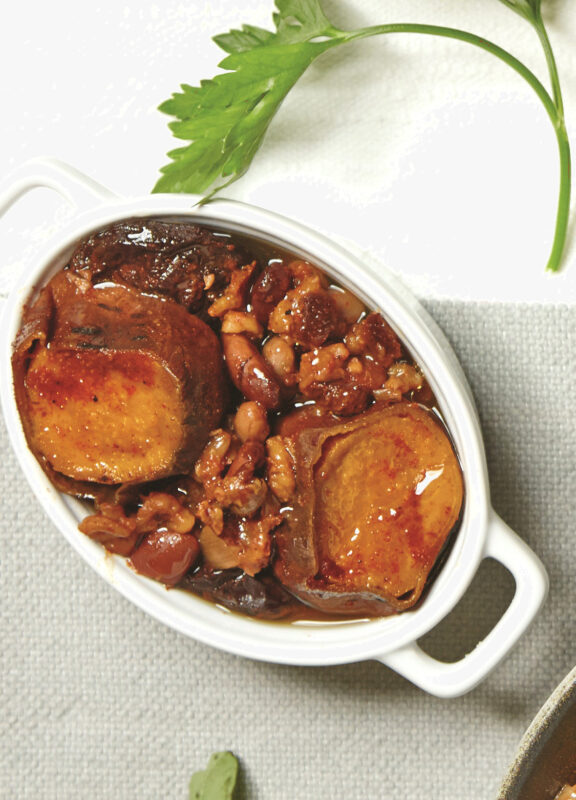
For those of you who don’t eat meat or want to serve your cholent at a dairy meal, this vegetarian cholent is the way to go. Unlike a traditional vegetarian bean soup or stew, this cholent will take on similar characteristics of a classic cholent because of the potatoes, beans, and dried figs. And for added texture and richness, add a vegetarian kishka to the crockpot.
Vegetarian Cholent with Kishke
Servings
8 Servings
Ingredients
- 3 yellow onions chopped
- 2 large carrots peeled and chopped
- 2 large potatoes chopped
- 6-8 prunes or dried figs
- 1/2 cup kidney beans
- 1/2 cup white beans
- 1/2 cup pearl barley
- 1 tablespoon garlic powder
- 1 tablespoon paprika
- 1 teaspoon chili powder
- 1 teaspoon salt
- 1/2 teaspoon pepper
- 1 vegetarian kishka
- 3-4 cups water
Instructions
- Place the onions, carrots, potatoes and prunes/figs in the bottom of the crockpot.
- Top with the beans and barley.
- Sprinkle on the garlic powder, paprika, chili powder, salt and pepper, top with the vegetarian kishke, then cover with water.
- Cover the crockpot and cook on low heat overnight, or for at least 8 hours.


If you are looking to make it without fat it will be very difficult. Originally it was all animal fat like schmaltz. Not really sure it can work oil free.
Do you have a no oil vegan kishke recipe you can share? Or maybe suggest an oil replacement?
THATS DANGEROUS RECIPE – Since most slow cookers do not reach the boiling point (212°F), beans prepared in them will carry the toxic lectin.
This recipe uses canned beans. You’re correct that, if dried kidney beans were used, they would produce the toxin lectin https://www.allrecipes.com/article/kidney-beans-slow-cooker/
However, canned or precooked kidney beans are not a problem.
Would textured soy pieces add to the flavor of the dish? What is the purpose of the figs/prunes?
BTW, I make my own parve kishke for years…I don’t like MSG and preservatives which come in ready made kishke
I am sure textured soy would be a great addition, the prunes and just for flavor, they are used in many Middle Eastern versions of cholent so it adds a nice layer of complexity.
Thanks so much for the comment, I have heard of the baking soda trick, but never knew it was from hard water. I find red kidney beans to be the most difficult to get right. Anyways, we do have lots of vegetarian Pesach ideas already on the site, will do our best to add more when the time comes.
Thank you, Tamar! You’re right about the red kidney beans – I find they need a few extra hours of soaking, but they do have a special heartiness that makes them worth the trouble, IMHO. Chatima tovah,
best from Miryam C., a/k/a WeWantPie (because, after all, doesn’t everybody love pie?)
Thank you for answering so quickly!! 🙂 I just love your joy of kosher book, I will have go buy another one soon, this one is almost worn out, LOL. btw. I am new to jewish cooking so I am learning a whole new language as well!! Ok, so…. I want to make my own kishka (because I have allergies and have to sub ingredients) so, just form it into balls or rolls and place them on top of the cholent and bake that way? I don’t even know what a kishka is, btw…is it like a bread consistency when it is cooked raw in the cholent? Thank you again for answering so quickly!!!!
Ahhhh this is so exciting!!!! Love that you need a new book!!! Ok so get ready for this… kishka means…. intestines and is essentially like a fat sausage shaped stuffed intestine made with a filling of fat, flour, seasoning and sometimes veg – AHHHHHH! But these days homemade and commercial varieties are much more appealing and often vegetarian (which is my favorite!). The consistency is really mushy almost like a super thick hot cereal/farina or a soft matzo ball – not quite sure how to describe it but it’s not bread like at all. Shape as a massive sausage or log and place it on top of the chulent to cook.
HI! Well, thank you for replying again so quickly!! Yes, this IS very exciting learning all this new information, LOL. 🙂
OK..so…to the Kishka. I made your vegetarian recipie (so YUMMIE!) and wrapped it up into a big loaf and wrapped THAT into parchment paper wrapped foil. Then, I dropped the whole thing into the veggie cholent (again, your recipie, btw). The very first thing after that was..uh, will the foil leach into my food this way?? The food cooked on low for 24 hours, because the beans were tough. SO, I have a problem with the foil, is that normal? The foil was in that cholent for over 24 hours!! :). Not so sure, but it was D-e-l-i-c-i-o-u-s, anyway.. whaddya thing about the foil thing? Does it matter? Thanks again for your informative posts!!! Bless you and your family!
Mika
thank you for the blessings RIGHT BACK AT YOU!!!! ok so personally I would not use the foil just the parchment but so glad it was soooooo good!
You’re welcome!! And thank YOU for the blessings, as well! 🙂 Always look toward the sun and you will never see the shadows!! Blessings!! 🙂
Hi lovely ladies – I know it’s months since your exchange, but I just want to toss in my 2 cents about tough beans: as a long-time crockpot lover and bean fan, I can tell you that a common reason for dry beans not getting soft and gooey like we want them is hard water. That is, if the water in your area is especially mineral-rich (like our delicious but not very bean-friendly tap water in NYC), your beans may not soften properly. The solution is to soak them ahead of time for a couple of hours in water with a generous tablespoon of baking soda. The baking soda will neutralize the acidity of the minerals and allow your beans to soften when you cook them. Just be sure to rinse the beans very thoroughly after soaking – you don’t want the baking soda to “neutralize” the flavors of other ingredients you’re going to use in your recipe, plus, it can sap some of the nutrients out of your beans if you don’t wash it away after it’s done its job.
BTW I am new to your site, Jamie, and I just adore you, your delicious haimische recipes, your sassy friends and your cool hubby. Looking forward to lots more recipes from you! (One particular request: when the time comes, could you post a bunch of vegetarian Pesach dishes? My shul is kosher vegetarian, and I always feel particularly challenged when it comes time to fix a main dish for one of our community Shabbat dinners and/or seders. Thanks and love!)
Usually it comes frozen and you put it in raw, on top and it cooks IN the cholent. When you remove the lid before serving you have 2 options. Option 1: gently lift out the kishka and slice and serve on the side. It is soft and will not slice neatly but you can go through the motions of slicing it/almost scoring it to delineate portion size OR simply serve it on the side with a spoon and just allow people to scoop the desired amount onto their plates. Option 2: mix and mush the kishka into the cholent before placing all into a serving vessel. This will integrate the cooked kishka into the entire cholent. Clear?
I am making vegetarian kiskha, btw. does it matter how long it cooks in the crockpot because it will be cooking overnight and through the next day? thank you!!! mika
is the kishka baked before it’s placed on top of the cholent in the crock pot? do you just put the raw dough in there or bake according the instructions first. thank you
hi please will you answer question? does the kishka cook in the crockpot along with the cholent, or, is it baked before hand then sliced and placed on top of the cholent? Seems it would get mushy? thank you for clearing this up for me.
Mika
It should work. We love cholent eggs.
I’d like to nestle some eggs in this cholent. Hopefully, it’ll work.
6 Quarts is best
Thank you for your quick response!
Which size crock pot is needed for this recipe?
Thanks for the comment Nate, sorry it didn’t turn out quite right for you, but glad you found some inspiration and the veggie sausage idea is a great one. You should try my Veggie Chicken and Apple Sausage Cholent if you can find the Tofurkey sausage – http://www.joyofkosher.com/recipes/vegetarian-chicken-apple-sausage-cholent/
Tamar Genger MA, RD
Executive Editor
http://www.joyofkosher.com
http://www.facebook.com/joyofkosher
Twitter @joyofkosher
I just tried this recipe, and I think it’s not great. The result is a little bland, and I find that dried figs are really unpleasant after 8 hours in the slow-cooker. I also recommend boiling the beans for a little while before putting them in the slow cooker (assuming you’re using dry, soaked beans, like I did). I find that the slow-cooker alone is not enough to take beans to perfection. I couldn’t find veggie Kishke, but I tried putting veggie sausage on top of the cholent to cook with it, and it was amazing! So that’s going to be part of my cholents now, and thanks for inspiring me to try that!
This is a question for the author of the recipe, Melinda: Where does one buy vegetarian kishke? Is there a certain brand that you use?
baking paper is a better option than foil
What is an alternative cooking method to the crockpot, I do not have one? Oven or cooktop?
Sarah’s Veggie Kishka
this is what i just took out of the oven….not my recipe….but they aren’t tough like regular kishke loaves–pretty soft– so i wonder if it would just fall apart in the cholent, if i dont leave it in the foil. what dya think?
3 large celery stalks with leaves, chopped
2-3 carrots, chopped
1 large onion, chopped
2-3 cloves garlic
¼ cup fresh parsley, chopped
½ cup oil
1 cup flour
½ Tbsp paprika
Salt and pepper to taste
Directions:
Preheat oven to 350°. Chop vegetables roughly then toss in a food processor. Pulse until veggies are minced. Remove to bowl and add oil, flour and spices. Stir until mixed. On a flat surface, lay down a square of foil covered by a smaller square of baking paper. Place about ¼ of the mixture on the edge of the baking paper and roll into a small cylinder. Twist ends of foil closed. Repeat until all the mixture is used up. Place foil rolls in a pan and cook on 350° for 1 hour. If serving with cholent, place baked foil rolls on top of cholent (inside the pot) and cook additionally until served on Shabbat.
Wow, your own kishke?? That’s amazing! I prefer to put my kishke directly in the cholent and not in foil.
i am planning to make my own kishke and when it’s finished do i place it in the cholent with the foil it”s cooked in or do i take it off and put it without the foil into the cholent?
thanks, I usually use canned but always have a variety of dry beans available for soups
For cholent, I highly recommend dried beans since this stew cooks for so many hours. Canned beans will break down and become too mushy.
question, dried beans or canned? or does it matter?