



The Jewish holiday of Hanukkah commemorates the discovery of a single vessel of pure olive oil that burned miraculously for eight days. Olive oil has always been an integral part of the Jewish tradition. Olive oil is one of the seven species mentioned in the Torah. The only mitzvah associated with Hanukkah is the lighting of the menorah and the Sages favored using olive oil, for both its purity and symbolism, in fulfilling this commandment. Can we even imagine our Hanukkah food traditions without olive oil?
A stroll through the section of the supermarket will assault you with a dizzying array of extra virgin, virgin, and pure olive oils ranging in price from just a few dollars to nearly $40 a bottle. With Hanukkah lights flickering in the background, and olive oil burning in my treasured silver menorah, I thought this is a perfect time to demystify olive oil and share some thoughts before for your next trip to the market.
The Orthodox Union considers extra virgin olive oil to be Kosher for Passover (and year round), even without any kosher supervision. Extra virgin olive oil is the highest grade of olive oil with a nearly perfect flavor, color and aroma that has a maximum acidity, of no more than 1%. It is also the most expensive of all olive oils, because optimal conditions for production, harvesting, processing and storage are rarely present and the production yield is low compared to oils.
Approximately, 98% of the world’s olive oil comes from the Mediterranean region, which has a history of olive tree cultivation that dates back nearly 6,000 years. Ancient olive presses have been identified by archaeologists in Israel and its neighboring countries. Most of the world’s finest olive oils come from this area, although California is now a leading producer of fine extra virgin olive oil. Like wine, the flavors, colors and aromas of aromas of olive oils vary according to type olive grown, as well as climate and soil conditions.
Health Benefits of Olive Oil
In addition to its colorful history and remarkable taste, olive oil is well known for its healthful properties. Widely respected scientific studies report that a Mediterranean diet low in saturated fats (such as butter and other animal fats), but rich in monounsaturated fats such as olive oil, in addition to grains, fruits and vegetables, helps keep the artery-clogging LDL (“bad cholesterol”) low while maintaining healthy levels of HDL (“good cholesterol”).
Cooking with Olive Oil
Chefs differ about whether to use extra virgin olive oil when cooking or frying. From my personal experience, the main reason to consider using other oils when frying is cost. The unique flavor of extra virgin olive oil is not as apparent when cooking, so I may fry with a peanut or grapeseed oil, but drizzle some extra virgin olive oil just prior to serving, for flavor. The International Olive Oil Council states that extra virgin olive oil, “stands up well to high frying temperatures. Its high smoke point (410ºF or 210ºC) is well above the ideal temperature for frying food (356ºF or 180ºC).”
Scroll to continue
More Love

Tu B’Shevat Vegetarian Celebration Menu
For many years, Tu B’Shevat was a holiday that flew under my radar—mostly associated with …
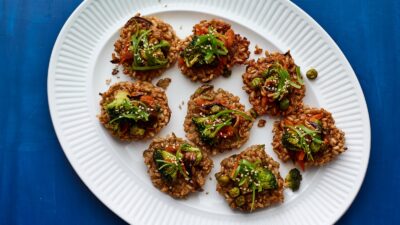
8 Latke Recipes That Are Not Made From Potatoes
Since I learned from Gil Marks a”h in his 5 Things You Never Knew About Latkes article …
Tasting Olive Oil
You can generally categorize olive oil as mild (delicate, light or “buttery”), semi-fruity (stronger, with more taste of the olive), and fruity (oil with robust olive flavor). The best way to become familiar with the wide range of olive oil flavors is to taste as many of them as possible! Art Kishiyama, the grower/producer of Olio Nuevo, shared his “Four S” tasting technique:
- SMELL – enjoy the fresh, clean, grassy aroma of freshly harvested olives.
- SIP – take a sip, let it rest on the tongue
- SLURP – suck air into the mouth through your teeth, coating the tongue and mouth with oil, enjoy the flavors.
- SWALLOW – slowly and carefully, anticipate a peppery, pungent finish
With these brief tasting tips in mind, let’s get cooking.
Here are 6 favorite ways to really experience olive oil.
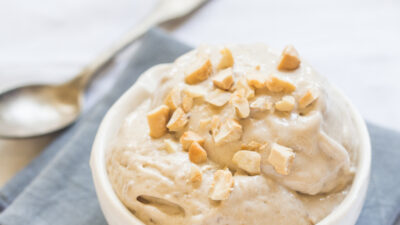
Roasted Fruit with Olive Oil and Ice Cream






Artesenal olive oil production (older technology of granite stones, etc.) does not automatically equal high-quality oil having low acidity or oxidation oil. In fact, modern equipment for extraction that is closed to the air with high efficiency offers a higher guarantee of extracting a purer quality olive oil of lower oxidation. Additionally, when starting with a high quality fruit, harvested very quickly and crushed within only a few hours of harvest before major enzymatic action or any fermentation begins, the results will be very different in ‘sippability’ and nuance of the oil. Such top-quality olive oils are typically stored well in a temperature controlled cellar environment preferably with the use of inert gas in the tanks to create an oxygen barrier.
Such truly sippable oils are clean, light in mouth feel (not greasy, heavy, oily), and offer beautiful lingering flavours.
Therefore, today an important question to as is not what country the oil comes from but who is the producer and what is their fruit cultivation and oil extraction process. Just an open-ended question if asking the producer or importer/distributor to ensure we do not influence the answer!
Italy has been a fantastic marketer of its food products and has been able to gain international reputation due to a variety of factors…including due to the emigration of many Italians overseas after the Second World War to diverse countries supporting their promotion of their olive oils and being one of the “first” in the market which is always a benefit for a product’s reputation.
Today as of 2014 there are many fantastic premium extra virgins from diverse countries. Premium being an olive oil with 0.1 acidity and peroxide levels below 6 or 7 units (extra virgin must have less than 20 units of peroxides per kilo).
In fact, I have just started to import an Israeli Kosher olive oil that has won Israel’s “First Harvest” competition a number of years in a row. Sindyanna of Galilee.
The world of olive oil is very interesting! Hope the above is of interest….Dolores Smith, The Olivar Corp.