


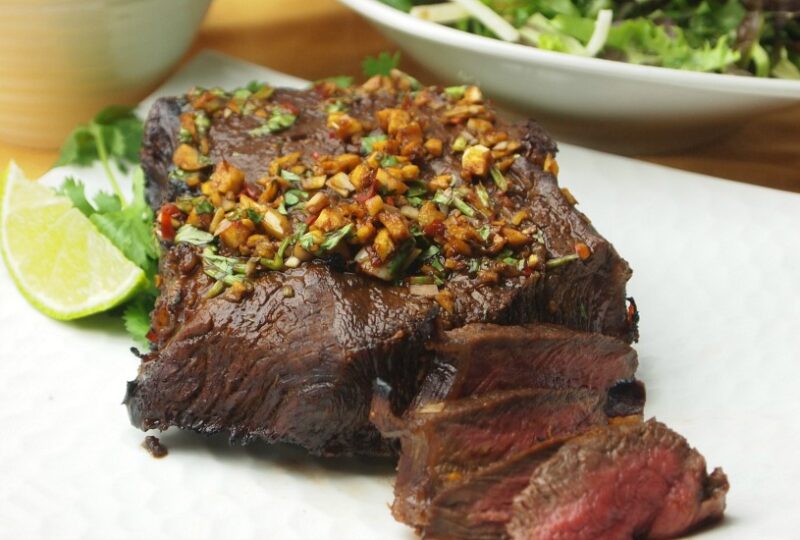
If I were to ask you where your steak comes from and your first answer is the supermarket, we need to talk. Long before a trimmed, perfectly portioned rib eye finds its way onto your grill or your plate, it starts with a cow and a cattle rancher. The Farm to Table Movement has caused many of us to think more about where our food comes from. Although I don’t yet (and can’t afford to fully) practice what I preach, our family is starting to eat more sustainable and natural foods, including grass-fed beef.
Some kosher consumers feel that eating animals raised in captivity challenges our goal for having greater sensitivity to the natural world. I’m not sure I’m entirely convinced by this argument, but grass-fed meat and pastured poultry seeks to find a thoughtful balance between the ethical and the practical.
According to the American Grassfed Association, an organization representing U.S. producers, food service industry personnel and consumer interest representatives, grass-fed animals “have eaten nothing but grass and forage from weaning to harvest, have not been raised in confinement, and have never been fed antibiotics or growth hormones.” In moderation, grass-fed meat is also healthy.
In addition to lower overall fat content, research published in Nutrition Journalsuggests that grass-based diets can significantly improve the fatty acid (FA) composition of beef, especially conjugated linoleic acid (CLA) (C18:2) isomers, trans vaccenic acid (TVA) (C18:1 t11), a precursor to CLA, and omega-3 (n-3). In addition, “cattle fed primarily grass significantly increased the omega-3 content of the meat and also produced a more favorable omega-6 to omega-3 ratio than grain-fed beef.” Grass-fed beef is also higher in precursors for Vitamin A and E and cancer fighting antioxidants, researchers say. Beef is also nutrient-rich, with eight times more vitamin B12, six times more zinc, and three times more iron than skinless chicken breast, according to the Cattlemen’s Beef Promotion and Research Board.
 Brisket In a Pot with Garlic
Now I want to be up front here, grain-fed beef is filling a need. We’ve got a big population to feed and modern agriculture and science is allowing us to serve the bellies of the many, but it’s nice to know that there are alternatives to the mass-produced grain-fed meat. Grass-fed meat is leaner and has a delicious, natural taste that I think you will really enjoy.
KOL Foods, founded by Devora Kimelman-Block, is reshaping today’s kosher diet with great-tasting sustainable, grass-fed meat and pastured poultry that is available to order online with affordable shipping anywhere in the United States.
Our family could not get enough of KOL Foods this holiday season – it definitely beat waiting in line at the butcher and I was able to create some amazing recipes that you will definitely want to try at home!
Scroll to continue
More Love
How To Make The Best Burgers
What’s the secret to making really great burgers at home? Really great meat! And very …
3 Indoor Beef Ribs Recipes
“I want my baby back…” Now that I’ve got you humming or singing the ubiquitous television …
Try my recipes, leave your comments and enter the giveaway:






Love grass fed beef
Definitely!!
I like the grass fed beef the best. Thanks.
My grandparents owned a farm and the only beef we ate was grass-fed.It is the only beef I know I can trust to be free of any toxins.
I grew up on a farm and I know grass-fed is better.
I would love to win this, sounds yummy!
Definitely, grass fed beef is better. It’s more natural and the cattle are eating what is natural for them.
Grass fed beef is definitely better quality and tastes better and is much more tender,My daughter is a baal shuvah and i wish i could get it for her but is is double the price of regular beef and they dont even sell it near where i live.
I think it is better. Used to get grass fed from a Kosher butcher and the meat was always so tender and not salty. He went out of business unfortunately.
My hubby loves to cook and would love this!
this meat cannot be beat
Would love to win!! A little low on cash so red meat is rare around here!
I love to cook!
Sounds great.
All that yummy meat products are making my mouth water.
Grass fed is better