


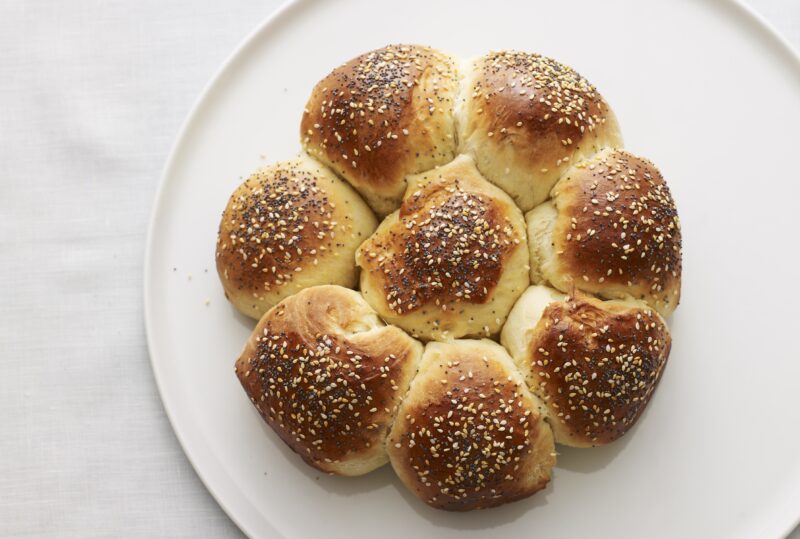
Here is my now-famous traditional challah recipe, scroll down for the full recipe, but first let me answer a few questions I am frequently asked.
What is challah?
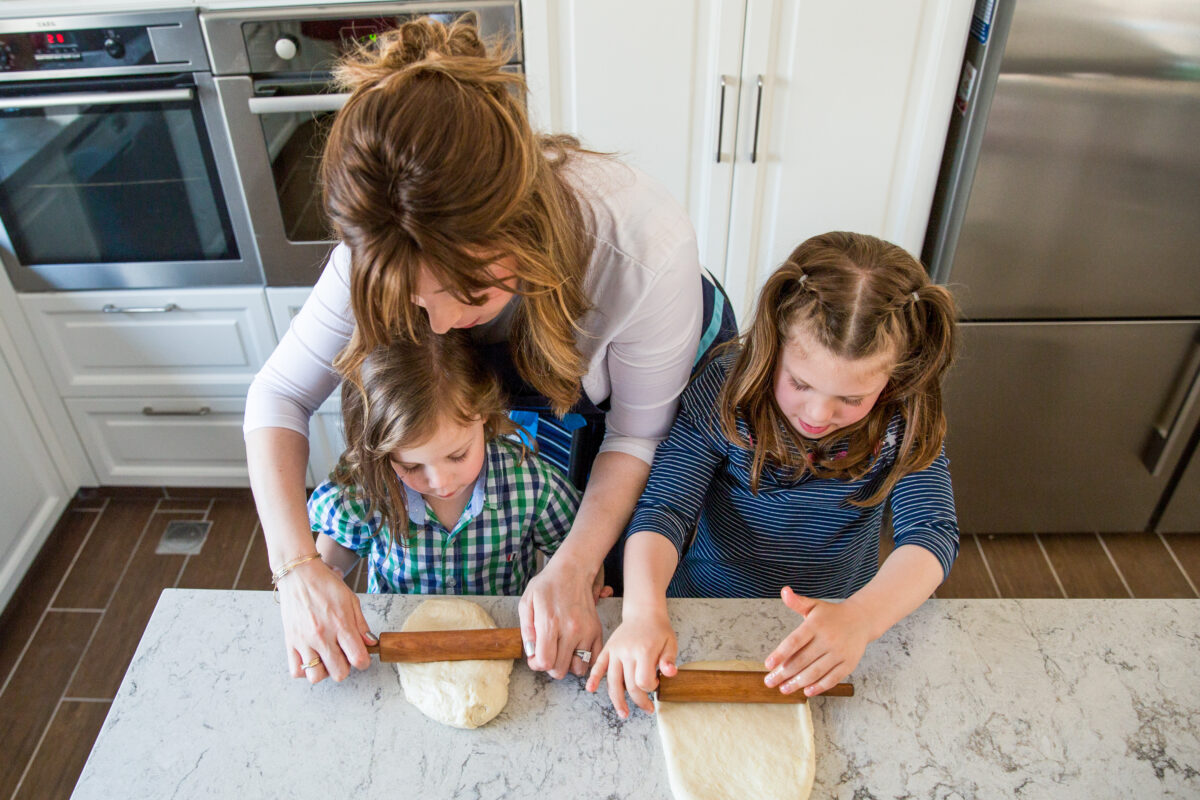
Challah is the Jewish egg bread served every week on Shabbat and is usually braided. You don’t have to top it, but I love it with everything bagel topping and I have a heavy hand. I make this recipe every week and I get so much satisfaction out of the kneading and braiding it is the one dish I don’t mind spending time on. And don’t forget to get the kids involved. Not only are they in my prayers, but they each get their own little mound of dough to shape and decorate as they like. I like everything spice, they like sprinkles, we are all happy. Enjoy this challah bread recipe this Shabbat and for many years to come.
What makes challah bread different?
Challah baking is part magic, part science and 100% spiritual. It’s not simply an egg bread that is made dairy-free with oil instead of butter. Challah touches the soul. Challah is one of those foods that is a spiritual key, placing it front and center at the start of all our Shabbos and holiday meals. We eat challah every Shabbos as an allusion to the manna that G-d showered on the Israelites in the desert after they left Egypt. The manna would fall every day, but it was just enough for one day. The Israelites had to learn to trust in G-d for their daily sustenance and not worry about tomorrow. That’s a pretty good lesson in itself. But the kicker is that every Friday a double amount would fall, so there would be enough to eat on Shabbos morning. We put two challahs on the Shabbos table, as a reminder of the Friday double portion of manna. Every week, we enjoy our challah. At the same time, we deepen our faith in G-d, who loves us so much that He provides us with everything we need day after day, from paying the mortgage down to my daughters’ Hello Kitty alarm clock. We reaffirm our allegiance to Shabbos, a day so special that we don’t cook or bake; we just eat delicacies we prepared on Friday.
Bread is for the body, but challah, challah touches the soul.
Can you eat challah bread anytime?
While challah is on the table for every Shabbat and holiday meal, it can be eaten any other time as well.
Why is challah bread so special?
There’s a reason challah pays spiritual dividends, but to understand it we have to visit ancient Israel for a minute. (Don’t worry. I’ll bring you back.) Back in the days of the Holy Temple in Jerusalem, people called Kohanim (a huge extended family, really) did not own farmland because their sole task was to serve in the Temple and teach the holy Torah to every Jew. The mitzvah (law) of giving them tithes and food gifts was mandated so they could devote themselves exclusively to this calling.
One of those gifts was called “challah,” which meant that whenever someone baked bread, he or she was to give a small portion of it to a friendly local Kohein. And the baker did not just drop a package on the doorstep and run. He would learn some Torah with the Kohein, maybe have a cup of tea and schmooze a while. This exchange not only fed the Kohanim and their families; it fortified the bond between average Israelites and their spiritual mentors.
Scroll to continue
More Love
Etrog Preserves
Turn your leftover Sukkot etrogs into preserves or jam to last the whole year. …

Classic Cholent
The Best Classic Cholent Recipe: Shabbat Morning Comfort, Just Like Bubby Made Growing up, …
It was a great system.
Today there’s no Holy Temple, but we still keep the mitzvah, called hafrashat challah, to elevate that simple act of baking bread to a spiritual activity.
How do you make challah bread?
Watch me make this challah dough in the video above and then learn to shape so many different ways with our Challah Shaping and Braiding Videos.
If you want to try the easiest challah ever, check out my No Knead Challah recipe here.
Looking for a healthier, 100% whole grain challah with all natural sweeteners? Get our Spelt Challah Recipe.
A few more things to consider before we get to the actual recipe.
The Flour: I always use flour that is high in gluten because gluten adds stickiness and sponginess to the dough. High-gluten flour will give you a nice chewy texture. Bread flour or bread machine flour are interchangeable with high-gluten flour. All-purpose flour can be subbed if necessary. This recipe calls for a 6-pound bag of high-gluten (bread) flour. But fear not if you can’t find a 6-pound bag: 3¼ cups of high-gluten flour equals 1 pound, and 3¾cups of all-purpose flour is equivalent to 1 pound.
You can find oval baking pans on Amazon to help keep the classic braided challah shape.
.

Jamie Geller’s Challah Recipe
Servings
Ingredients
- 2 ounces ¼ cup plus 2 tablespoons active dry yeast (57 grams) + 3 tablespoons sugar (40 grams)
- 6 cups warm water divided (1,440 grams)
- 4 tablespoons kosher salt 72 grams
- 1 6-pound bag high-gluten flour (2.7 kg)
- 2 cups sugar 400 grams
- 4 egg yolks
- 1 ¼ cup canola oil divided (260 grams)
- 2 whole eggs lightly beaten
- ½ cup sesame seeds
- ½ cup poppy seeds
Instructions
- In a medium bowl, dissolve yeast and 3 tablespoons of sugar in 2 cups of warm water, cover loosely with a towel and set aside.
- Place salt in a huge plastic bowl.
- Add flour to bowl.
- Add sugar and egg yolks.
- Yeast should now have bubbled/foamed and doubled in size, if yeast has not bubbled or does not seem active repeat the process again.
- Make a well in the middle of the flour mixture and slowly pour yeast and sugar water mixture into the well. Then add the remaining 4 cups of warm water into the well. Make sure the water is not too hot. It should be no warmer than you would use for a baby’s bath.
- Start kneading ingredients together and add a ½ cup of oil.
- For the next 10 minutes, knead, adding another ½ cup of oil slowly during that time as needed to create a workable dough. Dough shouldn’t be too sticky and also should not be dry. It should become one cohesive mass.
- Loosely cover dough with a large kitchen towel and place in a warm spot in your kitchen for 15 minutes.
- After 15 minutes, lightly oil your hand and knead again for another 5 minutes adding a touch more oil to the dough if necessary. The dough should now be easier to work with and will become smooth and satiny.
- Rub a little oil over the top and around the dough. Cover bowl with a kitchen towel. Place covered bowl in a medium plastic garbage bag and place open ends of the bag loosely underneath the bowl, trapping in air.
- Place in a warm spot and let rise for 1 hour or until doubled in size.
- Punch dough down and knead (lightly oil your hands if necessary), flipping it and releasing any air bubbles. Cover again, using the towel and the bag, and let rise 1 more hour.
- Lightly oil your hands, and punch down again. With a sharp knife divide dough into 4 equal parts.
- Liberally spray 4 (9-inch) round baking pans with non-stick cooking spray and set aside.
- Preheat oven to 375°F.
For Round Challah
- With lightly oiled hands, place 1 piece of dough on a smooth work surface. Play with the dough a bit, squeezing out any air bubbles. Then roll the dough into a long, thick rope, adding oil as needed to keep it from being too sticky. Don’t use too much oil; a little sticky is fine.
- Place one end of the rope up against the edge of the prepared pan and coil it, ending in the middle. Set aside.
For Pull-Apart Challah
- With lightly oiled hands, place 1 piece of dough on a smooth work surface. Play with the dough a bit, squeezing out any air bubbles. Separate into 8 equal parts. Roll each part into a round ball, adding oil as needed to keep it from being too sticky. Don’t use too much oil; a little sticky is fine.
- Place one ball in the middle of the prepared pan and surround with remaining balls. Don’t worry if they don’t touch. They will rise into each other while baking. Set aside.
- Repeat either method with remaining dough so that you have 4 challahs.
- Brush challahs with beaten egg and sprinkle with a combination of poppy and sesame seeds.
- Bake at 375°F for 10 minutes and then lower your oven temperature to 350 F and bake for an additional 35 to 45 minutes, until challah tops are dark golden brown.
- Allow to cool slightly before serving. Serve while still warm. Once the challah has been sliced, you can store the slices in sealable plastic bags for about 4 to 5 days.
- Recipe Courtesy of JOY of KOSHER Fast, Fresh Family Recipes by Jamie Geller (William Morrow/HarperCollins 2013) – BUY NOW
Notes:
- Make half the recipe as follows:
- ¾ ounce (21 g) active dry yeast
- 8 ounces (227 g) (or up to 10 ounces for sweeter challah) plus ½ ounce granulated sugar, divided
- 3 cups (708 g) warm water (90° to 100°F), divided
- 1-ounce (28 g) kosher salt
- 3 pounds (1,360 g)high-gluten (bread) or all-purpose four
- 2 large eggs, separated
- ½ cup (120 g) olive oil, more as needed for kneading and shaping
Substitutions
- Flour
- Spelt Flour: Step 2: Add 2 ¼ cups of water.
- 100% Whole Wheat Flour: Step 2: Add 2 ½ cups of water.
- Egg-Free
- Simply eliminate the egg yolks from the recipe and brush or spray the challah with water in place of egg wash for egg free challah. No other adjustments required.
- Sweeteners
- Less Sugar: Decrease the sugar to 4 ounces with no other adjustments required.
- Brown Sugar: Substitute brown sugar, for the granulated sugar in equal parts with no other adjustments required.
- Honey/Syrup: Substitute silan/date honey, bee’s honey or maple syrup in part or in place of sugar. Reduce water by the amount of “liquid” (moisture rich) sweetener you are using. For example, if using ½ cup honey decrease water by ½ cup.
- Yeast
- ¾ oz dry yeast = 2 oz fresh yeast




WOWWWWWWWWWWW. This is the most amazing comment — thank you so much for taking the time to let me know!!! I just started doing Challah Workshops in Jerusalem — would love to bake with you and “your” teens next May!!!
Hi, Jamie,
I love your challah recipe. My husband and I take teens to Israel every year in May. I make your challah for them to try when we are having prep classes for the trip. This year’s class really loved the challah, so for their senior dinner this evening, I made each of them their own loaf of challah. Two recipes made 22 1-lb loaves. I used a 4 strand braid and various toppings. They turned out spectacularly!
Hi! I actually do now let it rise once shaped and in the pan. I find it yields a lighter challah. so let it rise at least 30 minutes, no more than 1 hour. Over proofing can cause the challah to lose it’s shape. enJOY!
Hi, does the dough need to rise after it’s been placed in the pan or only for the 2 hours specified?
Hi, I was wondering–does the dough need to rise after I place it in the pan or just for the 2 hours specified?
It is really best to buy 2 bags of flour and follow the recipe with 6 pounds, then just save the bag to top off the recipe each time you make it. And yes bread flour is the same as high gluten flour.
This is by far my favorite challah recipe and I used to make it all the time. Then almost a year ago I moved 800 miles and now I can’t find 6lb bags of high gluten flour ANYWHERE. I can get 5lb bags of bread flour though- I’m pretty sure bread flour and high gluten flour are the same thing but is there any way to translate the measurements of the other ingredients to a 5lb bag? I tried figuring it out but Math eludes me…🤷🏼♀️
The easiest is to halve it and make 3 (1 1/2 pound) loaves and here is the exact amounts for that as found in our Challah Ebook which you can download here <https://www.joyofkosher.com/tag/challah-ebook/>:
¾ ounce active dry yeast
8 ounces (or up to 10 ounces for sweeter challah)plus ½ ounce granulated sugar, divided
3 cups warm water (90° to 100°F), divided
1 ounce kosher salt
3 pounds high-gluten (bread) or all-purpose four
2 large eggs, separated
½ cup canola oil, more as needed for kneading and shaping
*Tamar Genger MA, RD | **Director of Digital Media*
Kosher Network International | JamieGeller.com [email protected]
904.580.7050 ext 250
Hello Jamie!
I’d love to try your challah recipe! It looks so yummy. Is it possible to write exact measurements for 2 loaves please?
Some of your recipes specify using your 1-pound or 2-pound challah dough, but your recipes do not indicate what weight the dough constitutes.
Yes, that is a smart idea, I will edit it. Sorry if you had trouble.
If possible could you please edit the recipe so that the ingredients for the dough are separate from the 2 whole eggs, sesame seeds and poppy seeds and that they are under a header for example “challah topping”. I usually don’t have issues with this, but once in a while I bake early in the morning ; ) and this could be confusing and some may think it’s listed as part of the challah dough. Like I did this morning. Thanks in advance.
It sure does, Jamie didn’t even adjust anything when she moved.
Hi! Do you know if this recipe “works” in Israel?
Great question. We have tried it with mixed results, some of us like it with honey and some don’t. You can sub 1/2 for less sweet or a little more for more sweet.
Jamie, can I substitute honey for the sugar in your Classic or No Knead Challah recipes? If so, how much would I use? Love these videos.
You have 2 chances to freeze it. When you have formed it and it still has the 2nd rise you can freeze it and then thaw and allow to rise or
Once it is completely baked and cooled. Enjoy
Can the apple monkey bread be frozen ?
1st Mazel Tov on the upcoming Bas Mitzva (we have one too next week!). 2nd did you use my recipe?
mazel tov to you too! my daughter’s bas mitzvah is next week too (Friday by any chance??), but we’re celebrating after pesach, especially the challah making part. okay, to be perfectly honest, I did not use your recipe. it does look and sound amazing, but I do not have enough strength in my arms to knead by hand and I only use a challah recipe that can be done completely in the mixer. I did try it with 2 different challah dough recipes and I tried multiple times. the first problem was when I rolled out the circles, the dough wanted to shrink back. but even when I was able to make the circles and form the rose shapes, when I put them in the pans, they grew and lost their shape. I even tried spraying with oil so it wouldn’t rise too much, that helped a little. any advice for me?
I saw your video on rose challah rolls but it did not work for me! it was so hard to roll challah dough so fine and flat. also, they just kinda grew and spread in the oven so that they didn’t end up looking like anything (even though they were in little round pans). I really wanted to do flower challahs for my daughter’s bas mitzvah, but it is just not working. can you advise?
Sarah – I am sorry you found that to be the case. The challah shouldn’t be salty at all when using 6 pounds of flour. Did you by chance double check all your other ingredient measurements? If you like everything else about the recipe you can certainly pull back to 2-3TBS salt.
Can anyone help? I’m so confused.. I put in 4 tbsps kosher salt as per what I understood in the recipe and the dough is verrrrry salty.. did I do something wrong? Thank you..
Can’t wait to hear about your meal and how your family liked it. I would recommend looking on amazon. they sell several blends and most are kosher.
we have many brisket recipes on our site and I love the brisket in wine recipe. it is easy and delicious. ENJOY!
Hello Jamie! I’ve never made a complete shabbos meal myself before and I want to this week. I love all of your videos, cooking and aliyah, and I MUST make your challah, and one of the brisket recipes [I’ll take any suggestions on an awesome first time to impress the family :)]. Do you know where I can get the everything topping you used instead of poppy seeds? Also the flour, what brand would you suggest and where to get it? I am in Arizona so most likely I will be ordering it online if it’s something rare. Thanks!
Dependable makes 5, 6 and 7 pound bags of flour. The alternative is to measure your flour in cups. 3 1/4 cups of high-gluten flour equals 1 pound and 3 3/4 cups of all-purpose flour is equivalent to 1 pound.
Hi Aliza – I am sorry bc I don’t use fresh yeast and so I can’t say I have tested it but my research shows that
1 oz dry yeast = 3 oz fresh yeast. But I just checked Tamar Ansh’s Taste of Challah Cookbook and she shares a 16-17 cup (of flour) challah recipe (which roughly translates to 5lbs) which calls for 75 grams of fresh yeast (which roughly translates to 3 ounces.) And so that math would suggest that 6 pounds of flour would need 4.6 ounces of fresh yeast. So if you are concerned try 4.5 ounces of fresh yeast. Please let us know how it turns out.
I think you mean 3.6 oz
Gorgeous Yitzi!!!!
Oy I wish I met you!!! I was in Egypt too!!! What part where you? I wish I could email. There is plenty of challah made in Egypt! And because of the weather bread rises beautifully! Just have to becareful of an mosquitos. Mrs. Geller I wish to meet you one day you’re so lovely I love your recipes!
Leah – call me JAMIE!!!!! xoxo
Hi a few months back I asked about dry to fresh yeast conversion. You said to tripple it. Does this mean 2 oz of active dry would equal 6 oz of fresh yeast for this challah recipe? Doesn’t that sound like a lot of yeast to you for a 6 lb challah recipe??
I am in love with Jamie’s recipe for her challah! It comes out perfect every single time I make it and it keeps on coming out beautiful always! You must try this recipe!
I can’t find a 6# bag of flour anywhere (I live in Chicago suburbs). Do you have either a suggestion of where I can buy 6# bag or the appropriate quantities of all the other ingredients if I use a 5# bag of flour. Thanks
WOW — I am so so so thrilled!!! Thanks so very much for taking the time to let me know!
Hi T – if you sign up for our FREE emails at this link: http://www.joyofkosher.com/page/subscribe/ you will receive my Ultimate Challah Ebook which features a recipe for smaller quantities that is easily divided or multiplied:
If I were to use fresh yeast in this recipe how many ounces should I use to equal 2 oz of dry active yeast?
Here is what I found
The rule of thumb is dividing or multiplying by 3:
– from fresh yeast to dry – divide amount by 3, eg. instead of 30 grams of fresh yeast use 10 grams of dry
– from dry yeast to fresh – multiply by 3, meaning 7 grams or dry yeast becomes 21 grams of fresh.
From this website http://makebread.com.au/fresh-yeast-conversion/
let me understand so you are saying that 2 oz of dry yeast would equal 6 oz of fresh yeast for this challah recipe? Doesn’t this sound like a lot of yeast to you??
4 loaves? Is there maybe a single loaf recipe?
Thank you Jamie for this recipe. I have been making this challah recipe for over a year at least and each time it is a perfection. I cut the recipe so I can make one large challah at a time. I mean it when I say this recipe is a perfection and does not need to be modified in any way. I am so grateful that I found this recipe and because of it I am your great fan.
Hi Madison — I am sorry, unfortunately there is a lot of room for error when making challah a few of the issues to troubleshoot 1) did you proof your yeast? 2) you may have had to add more water (based on how fresh your flour was and the humidity level) 3) did you let it rise long enough? did it double in size at least? 4) make smaller challahs and free from — meaning on a baking sheet and not in a challah pan so there is plenty of room for the challah to grow and rise in all directions when baking.
Followed recipe exactly and my challah tuned out very heavy and dense; no idea where it went wrong…
Hey Betty! I am so happy you are enJOying the show and step 1 to making good bread is believing you can make good bread :-)!!!! In about 2 weeks I am launching a 100+ minute intensive video course called THE ULTIMATE CHALLAH COURSE where I breakdown how to make FAILPROOF! challah with an easy step-by-step video tutorial. I have also revised the recipe to make a smaller amount (working with 2 pounds of flour) AND fit for a stand mixer with a dough hook (or by hand if you prefer). Stay tuned and check back on our site or subscribe to our newsletter for more info.
YES AND YES!!! Absolutely both will work: braiding and freezing and bread flour, which is usually higher in gluten than all purpose, and even all purpose flour works beautifully — I have tested it on numerous occasions!
OMG I AM SO SO SO SO happy!!! Isn’t it incredible how versatile it is?!?!
Hi Dana — so happy you are loving the recipe. The whites are reserved for egg washing/brushing before baking but if you want to put in 1 whole egg in place of 2 yolks and then brush/egg wash with a whole egg that would work too. In theory for this recipe if you are kneading by hand you can add everything — the steps just ensure you don’t forget any ingredients and are designed to make the dough more manageable. I actually have a new challah video course (with a new and improved recipe) that I will be offering in a few weeks. And it will explain all the steps and reasons for adding each ingredient separately and much much much more. Keep an eye out for it on the site and via our newsletter.
Jamie
I just love you show. I love to make breads, but I do not believe I am that good at it.I was wondering if the callah recipe could be divided to make a smaller amount?
Hi Jamie! 2 questions…. your challah looks amazing and the challah that I make I am able to form it into a braid, freeze it and then when I’m ready to bake I let it come to room temp and rise, and then bake. Could I do that with yours as well??
And also, I can’t get high gluten flour, so could I just use bread flour?
Thanks! Looks amazing and I can’t wait t try!!!
This is my go to bread, actually the only bread I make now. Even the first time I made it, it turned out perfect. Tonight I had leftovers from last week’s bread and buns, so I tried your Challah Kugel. Wonderful!!!! Thank you.
I love this challah recipe! I made it once a few weeks ago and have it rising now getting ready for Shabbos! Can I use a whole egg instead of two egg yolks? I never know what to do with leftover whites or yolks for a recipe that uses one or the other. Also, could I simply add all ingredients after making the yeast mixture? Is there a reason to do it in all the steps and with the well? Thanks!
Oh Anita!!! What a lovely lovely comment thank you so much!!!
I love the challah. Your recipes are luscious and the advice reassuring. I’ll be happy to get news from you.
Oh Amy! That is so frustrating I am so sorry. Most likely it means your yeast is “dead”. Have you checked it by proofing it first in a bowl? Did it bloom to twice the size? Also is your water warm? are you using enough water? is your dough rising under cover in a warm and cozy spot of your kitchen?
It was a really old comment and the link was wrong, thanks for noting it, I changed it to the right link.