


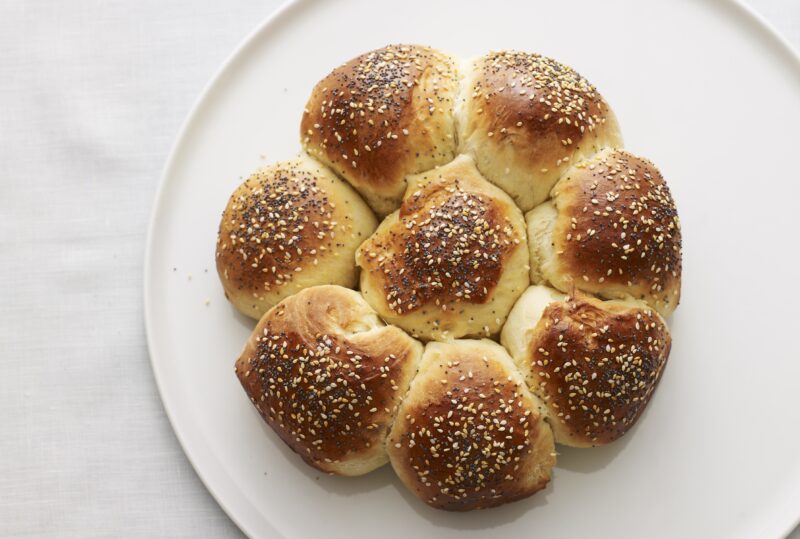
Here is my now-famous traditional challah recipe, scroll down for the full recipe, but first let me answer a few questions I am frequently asked.
What is challah?
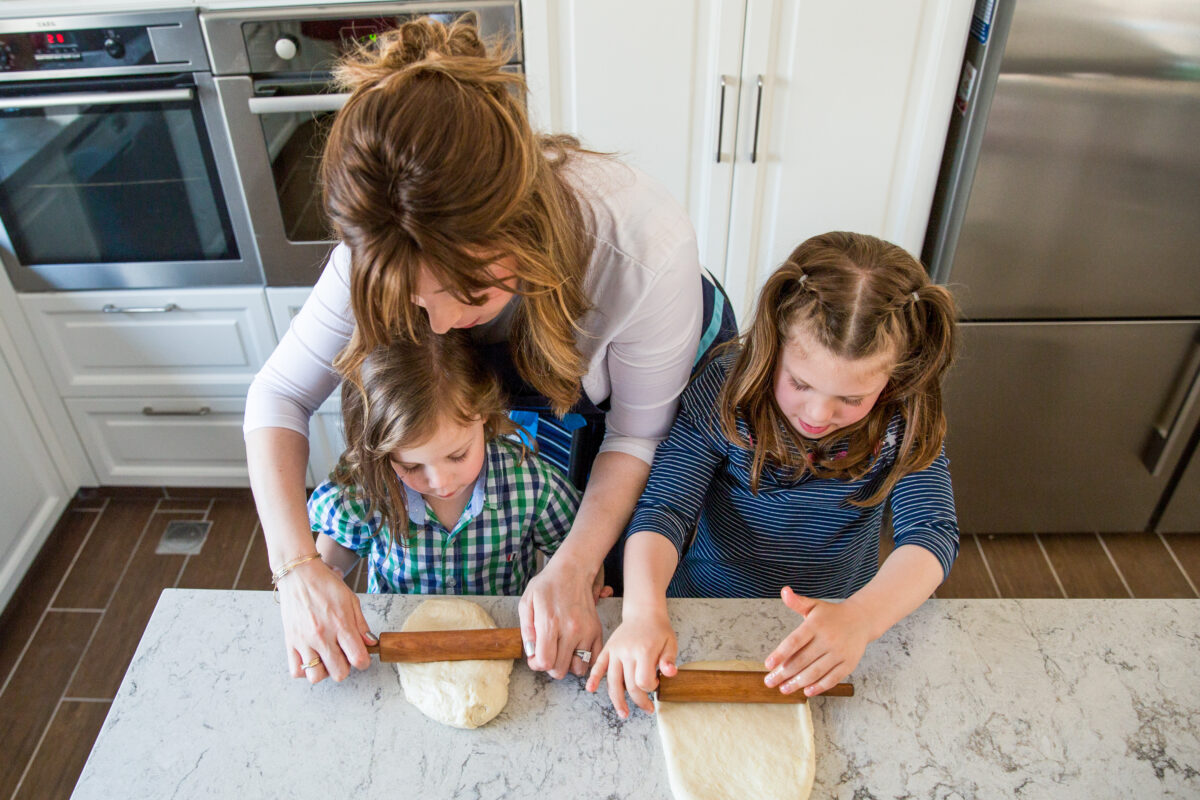
Challah is the Jewish egg bread served every week on Shabbat and is usually braided. You don’t have to top it, but I love it with everything bagel topping and I have a heavy hand. I make this recipe every week and I get so much satisfaction out of the kneading and braiding it is the one dish I don’t mind spending time on. And don’t forget to get the kids involved. Not only are they in my prayers, but they each get their own little mound of dough to shape and decorate as they like. I like everything spice, they like sprinkles, we are all happy. Enjoy this challah bread recipe this Shabbat and for many years to come.
What makes challah bread different?
Challah baking is part magic, part science and 100% spiritual. It’s not simply an egg bread that is made dairy-free with oil instead of butter. Challah touches the soul. Challah is one of those foods that is a spiritual key, placing it front and center at the start of all our Shabbos and holiday meals. We eat challah every Shabbos as an allusion to the manna that G-d showered on the Israelites in the desert after they left Egypt. The manna would fall every day, but it was just enough for one day. The Israelites had to learn to trust in G-d for their daily sustenance and not worry about tomorrow. That’s a pretty good lesson in itself. But the kicker is that every Friday a double amount would fall, so there would be enough to eat on Shabbos morning. We put two challahs on the Shabbos table, as a reminder of the Friday double portion of manna. Every week, we enjoy our challah. At the same time, we deepen our faith in G-d, who loves us so much that He provides us with everything we need day after day, from paying the mortgage down to my daughters’ Hello Kitty alarm clock. We reaffirm our allegiance to Shabbos, a day so special that we don’t cook or bake; we just eat delicacies we prepared on Friday.
Bread is for the body, but challah, challah touches the soul.
Can you eat challah bread anytime?
While challah is on the table for every Shabbat and holiday meal, it can be eaten any other time as well.
Why is challah bread so special?
There’s a reason challah pays spiritual dividends, but to understand it we have to visit ancient Israel for a minute. (Don’t worry. I’ll bring you back.) Back in the days of the Holy Temple in Jerusalem, people called Kohanim (a huge extended family, really) did not own farmland because their sole task was to serve in the Temple and teach the holy Torah to every Jew. The mitzvah (law) of giving them tithes and food gifts was mandated so they could devote themselves exclusively to this calling.
One of those gifts was called “challah,” which meant that whenever someone baked bread, he or she was to give a small portion of it to a friendly local Kohein. And the baker did not just drop a package on the doorstep and run. He would learn some Torah with the Kohein, maybe have a cup of tea and schmooze a while. This exchange not only fed the Kohanim and their families; it fortified the bond between average Israelites and their spiritual mentors.
Scroll to continue
More Love
Etrog Preserves
Turn your leftover Sukkot etrogs into preserves or jam to last the whole year. …

Classic Cholent
The Best Classic Cholent Recipe: Shabbat Morning Comfort, Just Like Bubby Made Growing up, …
It was a great system.
Today there’s no Holy Temple, but we still keep the mitzvah, called hafrashat challah, to elevate that simple act of baking bread to a spiritual activity.
How do you make challah bread?
Watch me make this challah dough in the video above and then learn to shape so many different ways with our Challah Shaping and Braiding Videos.
If you want to try the easiest challah ever, check out my No Knead Challah recipe here.
Looking for a healthier, 100% whole grain challah with all natural sweeteners? Get our Spelt Challah Recipe.
A few more things to consider before we get to the actual recipe.
The Flour: I always use flour that is high in gluten because gluten adds stickiness and sponginess to the dough. High-gluten flour will give you a nice chewy texture. Bread flour or bread machine flour are interchangeable with high-gluten flour. All-purpose flour can be subbed if necessary. This recipe calls for a 6-pound bag of high-gluten (bread) flour. But fear not if you can’t find a 6-pound bag: 3¼ cups of high-gluten flour equals 1 pound, and 3¾cups of all-purpose flour is equivalent to 1 pound.
You can find oval baking pans on Amazon to help keep the classic braided challah shape.
.

Jamie Geller’s Challah Recipe
Servings
Ingredients
- 2 ounces ¼ cup plus 2 tablespoons active dry yeast (57 grams) + 3 tablespoons sugar (40 grams)
- 6 cups warm water divided (1,440 grams)
- 4 tablespoons kosher salt 72 grams
- 1 6-pound bag high-gluten flour (2.7 kg)
- 2 cups sugar 400 grams
- 4 egg yolks
- 1 ¼ cup canola oil divided (260 grams)
- 2 whole eggs lightly beaten
- ½ cup sesame seeds
- ½ cup poppy seeds
Instructions
- In a medium bowl, dissolve yeast and 3 tablespoons of sugar in 2 cups of warm water, cover loosely with a towel and set aside.
- Place salt in a huge plastic bowl.
- Add flour to bowl.
- Add sugar and egg yolks.
- Yeast should now have bubbled/foamed and doubled in size, if yeast has not bubbled or does not seem active repeat the process again.
- Make a well in the middle of the flour mixture and slowly pour yeast and sugar water mixture into the well. Then add the remaining 4 cups of warm water into the well. Make sure the water is not too hot. It should be no warmer than you would use for a baby’s bath.
- Start kneading ingredients together and add a ½ cup of oil.
- For the next 10 minutes, knead, adding another ½ cup of oil slowly during that time as needed to create a workable dough. Dough shouldn’t be too sticky and also should not be dry. It should become one cohesive mass.
- Loosely cover dough with a large kitchen towel and place in a warm spot in your kitchen for 15 minutes.
- After 15 minutes, lightly oil your hand and knead again for another 5 minutes adding a touch more oil to the dough if necessary. The dough should now be easier to work with and will become smooth and satiny.
- Rub a little oil over the top and around the dough. Cover bowl with a kitchen towel. Place covered bowl in a medium plastic garbage bag and place open ends of the bag loosely underneath the bowl, trapping in air.
- Place in a warm spot and let rise for 1 hour or until doubled in size.
- Punch dough down and knead (lightly oil your hands if necessary), flipping it and releasing any air bubbles. Cover again, using the towel and the bag, and let rise 1 more hour.
- Lightly oil your hands, and punch down again. With a sharp knife divide dough into 4 equal parts.
- Liberally spray 4 (9-inch) round baking pans with non-stick cooking spray and set aside.
- Preheat oven to 375°F.
For Round Challah
- With lightly oiled hands, place 1 piece of dough on a smooth work surface. Play with the dough a bit, squeezing out any air bubbles. Then roll the dough into a long, thick rope, adding oil as needed to keep it from being too sticky. Don’t use too much oil; a little sticky is fine.
- Place one end of the rope up against the edge of the prepared pan and coil it, ending in the middle. Set aside.
For Pull-Apart Challah
- With lightly oiled hands, place 1 piece of dough on a smooth work surface. Play with the dough a bit, squeezing out any air bubbles. Separate into 8 equal parts. Roll each part into a round ball, adding oil as needed to keep it from being too sticky. Don’t use too much oil; a little sticky is fine.
- Place one ball in the middle of the prepared pan and surround with remaining balls. Don’t worry if they don’t touch. They will rise into each other while baking. Set aside.
- Repeat either method with remaining dough so that you have 4 challahs.
- Brush challahs with beaten egg and sprinkle with a combination of poppy and sesame seeds.
- Bake at 375°F for 10 minutes and then lower your oven temperature to 350 F and bake for an additional 35 to 45 minutes, until challah tops are dark golden brown.
- Allow to cool slightly before serving. Serve while still warm. Once the challah has been sliced, you can store the slices in sealable plastic bags for about 4 to 5 days.
- Recipe Courtesy of JOY of KOSHER Fast, Fresh Family Recipes by Jamie Geller (William Morrow/HarperCollins 2013) – BUY NOW
Notes:
- Make half the recipe as follows:
- ¾ ounce (21 g) active dry yeast
- 8 ounces (227 g) (or up to 10 ounces for sweeter challah) plus ½ ounce granulated sugar, divided
- 3 cups (708 g) warm water (90° to 100°F), divided
- 1-ounce (28 g) kosher salt
- 3 pounds (1,360 g)high-gluten (bread) or all-purpose four
- 2 large eggs, separated
- ½ cup (120 g) olive oil, more as needed for kneading and shaping
Substitutions
- Flour
- Spelt Flour: Step 2: Add 2 ¼ cups of water.
- 100% Whole Wheat Flour: Step 2: Add 2 ½ cups of water.
- Egg-Free
- Simply eliminate the egg yolks from the recipe and brush or spray the challah with water in place of egg wash for egg free challah. No other adjustments required.
- Sweeteners
- Less Sugar: Decrease the sugar to 4 ounces with no other adjustments required.
- Brown Sugar: Substitute brown sugar, for the granulated sugar in equal parts with no other adjustments required.
- Honey/Syrup: Substitute silan/date honey, bee’s honey or maple syrup in part or in place of sugar. Reduce water by the amount of “liquid” (moisture rich) sweetener you are using. For example, if using ½ cup honey decrease water by ½ cup.
- Yeast
- ¾ oz dry yeast = 2 oz fresh yeast




I’ve been looking for this recipe for a long time. Shabbat Shalom.
Yes the second rise is usually best.
Most recipes call for one main rise (doubling), then braiding, then another rise (while braided). Is this correct?
I have been allowing it to rise twice THEN braiding it. My challah is delicious but cutting out that second rise would be a lot faster! LOL
Hello. Is there high gluten flour available in israel? And if there is how is it called?
Hello. Do you know if in israel there is high gluten flour? And how is called? Thanks
Thanks so much for sharing this, I updated the oil amount because it did seem off and in my opinion always better to use less oil.
*Tamar Genger MA, RD | **Director of Digital Media*
Kosher Network International | JamieGeller.com [email protected]
Hi there, I just made this recipe for the second time, first time I only did a 1/4 batch to test it out, but this time I ran into issues. I was using the weight measurements for everything and the oil seemed like way to much. I checked the weight of my canola oil and 1 cup is only about 210g, so the 1-1/4c should be closer to 260g instead of 375g. I double checked the other measurements cause I got worried by loaves would have issues and the only other ingredient that looked off was the sugar. 2 cups of white sugar is closer to 420g than 400g, although that wouldn’t make a big difference.
jamie, i love your beautiful round apple challah for rosh hoshana. Can i make in advance and freeze? thank you.
The apple challah can be made ahead and frozen, it might be slightly better fresh but will still be excellent.
Can you bake in a challah mold instead of braiding? If so how long to bake and what temp. Also if using a dough hook in a mixer would you still make the dough a swritten but just transfer to the mixer for kneading and knead as written
Sure you can bake in a challah mold, it will depend on the size of the mold, best to follow the directions that come with the mold. And yes you can mix and knead in a machine with dough hook as long as the machine can handle the amount.
I’ve been trying to make a great Challah for many years. I was a bit sceptical about the amount of oil Jamie uses – but it was a great challah – the family loved it and voted it the best they’ve tasted – even better than the most well known Sydney kosher bakeries.
Jamie, I JUST saw your response when I was trying to remember how to do a 6 strand braid! When we are able to get back to Israel, I’d love to see if we could do a collaboration with you! Praying you and yours are all well!! https://uploads.disquscdn.com/images/249b0f5d3a0765ddd4ef03c721c30ac2c5652b5f2b882975108fc995ac383697.jpg
Gorgeous
Thanks!
I thought you meant difficult to work with but maybe you mean the dough is tough, for that you should let it proof longer, even after you start rolling you can leave it for 10 minutes before continuing.
ok, thank you, i will try that
i do, and it does help a bit, but it is still a bit tough.
any other suggestions?
hi i like the taste of the challah, and I dont mind the time it takes for the recipe, and I have made this recipe three times so far. the first time with 6 lbs and the second with the half recipe.
i have found that the dough is very tough to work with, and I do not know how to compensate, should I be adding more water?
should i be kneading longer (I use a mixer)
Jamie uses oil to roll the dough and shape it, maybe try that?
Hi!
Is there any way to scale this recipe down? Because I don’t have a lot of spare time, and what has worked great with other challah recipes I’ve tried is to use my bread machine on the dough cycle, then take it out for shaping and last rise. I’d love to do that with this recipe but obviously no home bread machine will work with that 6 lbs of flour. So is there anyway to scale this down to like using 5 or 6 cups of flour?
Yes you can scale it down, the half recipe is already written above you can then halve it again and that should fit in a bread machine
I just added the halved recipes with 1.3 Kg of flour to the bottom of the recipe, you can halve that if you want to use less than 1 bag.
Thank you so much for your guidance, Tamar. I’m not very good with guesstimating when a dough is right so I cling to my set of scales, but I know all flours can react differently to humidity etc., so I’m going to loosen up a bit and just aim to get a nice silky dough. I think I’ll try half the recipe as a trial run and build some experience. Thank you again for your help. 🙂
My pleasure!
*Tamar Genger MA, RD | **Director of Digital Media*
Kosher Network International | JamieGeller.com [email protected]
Hi thanks so much for writing, sorry we don’t have it written with weights, I don’t know for sure but I would think based on google that the 1 cup of sugar would be 200 grams and 1 cup water is 240 mls or grams, and oil would be 300 grams. As for the yeast, I have read that the only difference between instant and active dry is that active dry needs to be mixed with water first and instant doesn’t, although if you used it in this recipe you can still do it that way, but you don’t need to. Still the amounts seem to be the same. It is quite a lot of yeast, but it is a lot of flour so you would need 8 packs. If you are worried about using so much and you want to go with less yeast you may just need to adjust the rising time, it will take longer to rise with less yeast. Hope that helps and hope it comes out delicious.
Hello everyone – I’d love to try this recipe (I haven’t had challah since I was a kid and my grandmother used to make it and I’ve such fond memories), but I’m in the UK and I’m not sure how the cup measurements translate into millimetres for liquids, and grams for sugar. I’m okay with the flour! It’s just over 2.7kg, I think, but would a cup of sugar be around 220 grams or about 8 ounces? And would a cup of water or milk be around 220 ml? I’m lost with the oil – is a cup and a quarter about 275ml total oil? One last question, we mostly use sachets of instant yeast which you just chuck in the breadmaker. One sachet is 7 grams (a quarter of an ounce) and I’m not sure how they react to being mixed with water and sugar and set aside. Do you think it would be okay? One sachet is enough for a large loaf, so maybe I should use about 4? I think it’s more powerful yeast than active dried and I don’t want to end up with a really strong yeasty flavour, not to mention create an unstoppable dough monster that escapes the bowl. 🙂 Sorry for all the questions, but I’d love to get this just right for my mother and recreate some memories. Probably impossible, but I can try!
Finally. After experimenting with so many different recipes, this is the one for my table! Thank you
Hi, would I be able to make this dough about a week in advance, then shape and bake it later in the week? How would I store it? Thanks so much!
Yes, that works fine
I really want to try this recipe. But I can’t find hi gluten flour can I use regular קמח חיטה.
It would be 18 teaspoons
Hi, how much yeast would this be in teaspoons?
It’s about 15 inches round and 5.5 inches tall. Happy challah making!
C) you can multiply this recipe by as much as you’d like! Technically I haven’t tried it more than x2 but it should work.
D) you can use the whole eggs.
Happy Challah Baking.
A) I don’t have exact weight for the baked loaves but they are 4 large — you can make 6 medium
B) Yes in theory but it’s a lot of dough so you prob have to do it in 2 rounds unless you have an extra large or industrial sized machine.
You can halve the recipe and make 2 large loaves.
Hi! What would be the recipe for 2 loaves? Thank you!
This looks like a great recipe. I have a number of questions:
A) What is the weight of the dough (4 loaves of ? pounds each)?
B) Can this recipe be made in a large mixer with a dough hook?
C) How many times can this recipe be made (ie: x3, x4, x5..)?
D) Can whole eggs be used or only the yolks?
thank you
6 pounds is 2.7 kg
I saw your challah making video in your kitchen with friends. Awesome. Brilliant idea with the garbage bag. I’m going to make the recipe but want to get an idea of scale. How big is that bowl you use to mix the dough?
I’d like to try, could you help me? 6 pound flour in Kg? Thank you